 By mrahmat
Executive Summary
Hazards—whether natural, technological, or anthropogenic—pose increasing threats to organizational continuity, community safety, and economic stability. In an interconnected, globalized world, hazard management must evolve from reactive response mechanisms to proactive, integrated frameworks of anticipation, preparedness, mitigation, and resilience-building.
This article provides a comprehensive overview of modern hazard management practices, including hazard classification, risk assessment, mitigation strategies, and emerging trends. It targets decision-makers across industries, especially those involved in safety, sustainability, governance, and continuity planning.
I. Understanding Hazards: Definition and Scope
A hazard is any agent or condition with the potential to cause harm to people, property, infrastructure, ecosystems, or economic systems. Hazards can be natural, technological, or human-induced and often act as catalysts for larger systemic failures when unmanaged.
1. Categories of Hazards
A. Natural Hazards
-
Earthquakes
-
Hurricanes and tropical storms
-
Floods
-
Wildfires
-
Volcanic eruptions
-
Droughts
-
Tsunamis
B. Technological Hazards
-
Chemical spills
-
Industrial explosions
-
Nuclear accidents
-
Power grid failure
-
Infrastructure collapse
-
Cyberattacks (increasingly regarded as technological hazards)
C. Anthropogenic Hazards
-
Armed conflict and terrorism
-
Civil unrest
-
Environmental degradation
-
Pandemics (as zoonotic spillovers often link human activity to biological hazard propagation)
-
Economic collapse and systemic market failures
II. Risk vs. Hazard: Clarifying the Terminology
Many organizations conflate hazard with risk, yet the distinction is critical:
-
A hazard is the potential source of harm.
-
Risk is the likelihood of that hazard occurring and its impact.
Formula:
Risk = Probability × Severity
Thus, a hazard with low probability but high severity (e.g., nuclear meltdown) still demands strategic consideration, even if infrequent.
III. The Hazard Management Lifecycle
Effective hazard management integrates across four interlocking phases:
1. Prevention and Mitigation
-
Goal: Reduce the likelihood and/or impact of hazards.
-
Examples:
-
Building levees for flood protection
-
Earthquake-resistant construction
-
Hazardous material (HAZMAT) zoning laws
-
2. Preparedness
-
Goal: Build capacity to respond rapidly and effectively.
-
Tools:
-
Emergency response plans (ERPs)
-
Training and simulations (e.g., fire drills, table-top exercises)
-
Public communication systems
-
Supply chain contingencies
-
3. Response
-
Goal: Limit damage and protect life during and immediately after a hazard event.
-
Activities:
-
Evacuation and rescue operations
-
Medical response and trauma support
-
Communication and coordination with stakeholders
-
Rapid damage assessment
-
4. Recovery
-
Goal: Restore systems to normal or improved states.
-
Actions:
-
Rebuilding infrastructure
-
Financial compensation and insurance claims
-
Psychological support
-
Policy reviews and resilience upgrades
-
IV. Hazard Identification and Risk Assessment (HIRA)
1. Hazard Identification
A systematic process of discovering potential hazards through:
-
Site assessments
-
Historical data analysis
-
Regulatory audits
-
Environmental scans
2. Vulnerability Assessment
Evaluating susceptibility of people, assets, and operations. Factors include:
-
Age of infrastructure
-
Population density
-
Geographic exposure
-
Socioeconomic vulnerability
3. Consequence Modeling
Simulates scenarios to estimate likely impacts. Common tools include:
-
GIS hazard mapping
-
Monte Carlo simulations
-
Fault tree and event tree analysis
-
AI-driven risk models (emerging)
4. Risk Ranking
Prioritizing hazards based on probability and consequence to allocate resources effectively.
V. Strategic Mitigation: Organizational Levers
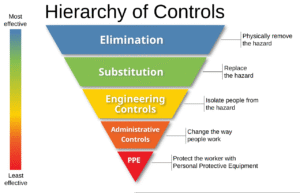
1. Engineering Controls
-
Fire suppression systems
-
Seismic base isolators
-
Smart grid redundancies
2. Administrative Controls
-
Standard operating procedures (SOPs)
-
Shift scheduling to minimize fatigue
-
Access control policies
3. Personal Protective Equipment (PPE)
-
Mandatory in manufacturing, healthcare, chemical sectors
4. Process Safety Management (PSM)
A regulatory framework (e.g., OSHA’s PSM in the U.S.) designed to prevent hazardous chemical releases through systematic engineering and procedural controls.
VI. Crisis Leadership and Communication
1. Crisis Command Structures
-
Incident Command System (ICS)
-
Business Continuity Management (BCM)
-
Emergency Operations Centers (EOC)
2. Crisis Communication Principles
-
Accuracy over speed
-
Transparency builds trust
-
Multichannel dissemination
-
Two-way communication
Case in point: Organizations with robust internal crisis communication during COVID-19 outperformed peers in employee trust and operational resilience.
VII. Industry Applications and Sector-Specific Risks
A. Energy Sector
-
Hazards: Pipeline leaks, refinery fires, offshore drilling accidents
-
Solutions: Remote monitoring, SCADA system cybersecurity, blowout preventers
B. Construction
-
Hazards: Falls, structural collapse, heavy equipment accidents
-
Solutions: Job hazard analysis (JHA), PPE enforcement, site inspections
C. Healthcare
-
Hazards: Pathogen exposure, patient aggression, equipment failure
-
Solutions: Infection control protocols, risk-based staffing, AI triage tools
D. Education
-
Hazards: Active shooter situations, lab accidents, natural disasters
-
Solutions: Safe school design, lockdown procedures, emergency drills
E. Manufacturing
-
Hazards: Machinery entrapment, chemical exposure, explosions
-
Solutions: Lockout/tagout procedures, chemical inventory control, combustible dust mitigation
VIII. Case Studies: Lessons from Failure and Success
1. Chernobyl Nuclear Disaster (1986)
-
Root cause: Lack of safety culture, flawed reactor design, suppressed reporting
-
Lesson: Transparency and engineering redundancy are non-negotiable
2. Fukushima Daiichi (2011)
-
Cause: Earthquake + tsunami overwhelmed plant defenses
-
Lesson: Compound hazards require scenario stacking, not siloed planning
3. Deepwater Horizon (2010)
-
Cause: Cost-cutting led to ignored safety warnings
-
Lesson: Safety culture must be board-mandated and metrics-driven
4. COVID-19 Pandemic (2020–)
-
Global hazard with cascading health, economic, and social impacts
-
Lesson: Preparedness must extend beyond physical assets to supply chains, digital resilience, and public communication
IX. Emerging Trends in Hazard Management
1. Digital Twins for Scenario Planning
Simulated replicas of physical systems used to stress-test responses to hazards in real time.
2. AI and Predictive Analytics
Machine learning models are increasingly used to:
-
Predict floods and wildfires
-
Detect equipment anomalies
-
Optimize evacuation routes
3. Climate-Integrated Risk Management
Forward-looking hazard strategies now incorporate climate modeling:
-
Sea level rise projections
-
Changing storm frequency
-
Wildfire spread zones
4. Supply Chain Hazardization
Global supply chains now require hazard mapping:
-
Natural disaster risk at suppliers
-
Geopolitical instability
-
Cyberattack vulnerability at logistics nodes
X. Policy, Compliance, and Global Frameworks
1. Sendai Framework for Disaster Risk Reduction
UN-led strategy promoting disaster preparedness, risk governance, and global cooperation.
2. ISO 31000 – Risk Management
Provides principles and guidelines to manage risk holistically.
3. OSHA, EPA, and National Regulations
Country-specific frameworks drive compliance:
-
Hazardous waste handling
-
Workplace safety
-
Chemical spill response
4. ESG Integration
Hazard mitigation increasingly overlaps with environmental and social governance metrics, especially for:
-
Climate risks (E)
-
Worker safety (S)
-
Crisis preparedness (G)
XI. Building a Culture of Resilience
Hazard mitigation is not just technical—it’s cultural.
1. Executive Commitment
Leadership must prioritize safety in strategic plans and reporting structures.
2. Employee Empowerment
Every worker should be trained, informed, and empowered to act on safety concerns without fear of reprisal.
3. Continuous Learning
Organizations must conduct after-action reviews, update risk registers, and continuously iterate based on new data.
Conclusion: Hazards are Inevitable—Disasters Are Not
Hazards will continue to emerge and evolve—but with proper planning, investment, and culture, their impact can be contained. Organizations must shift from reactive posture to strategic resilience. In the 21st century, hazard management is not optional—it is an existential necessity for corporate survival, public safety, and economic continuity.
https://www.linkedin.com/pulse/enterprise-risk-management-21st-century-resilient-b%C3%A4ckman-ambci
https://onlinelibrary.wiley.com/doi/abs/10.1002/9781119932475.ch7
https://www.osha.gov/safety-management/hazard-prevention