 By Vivian Lee Yao Ting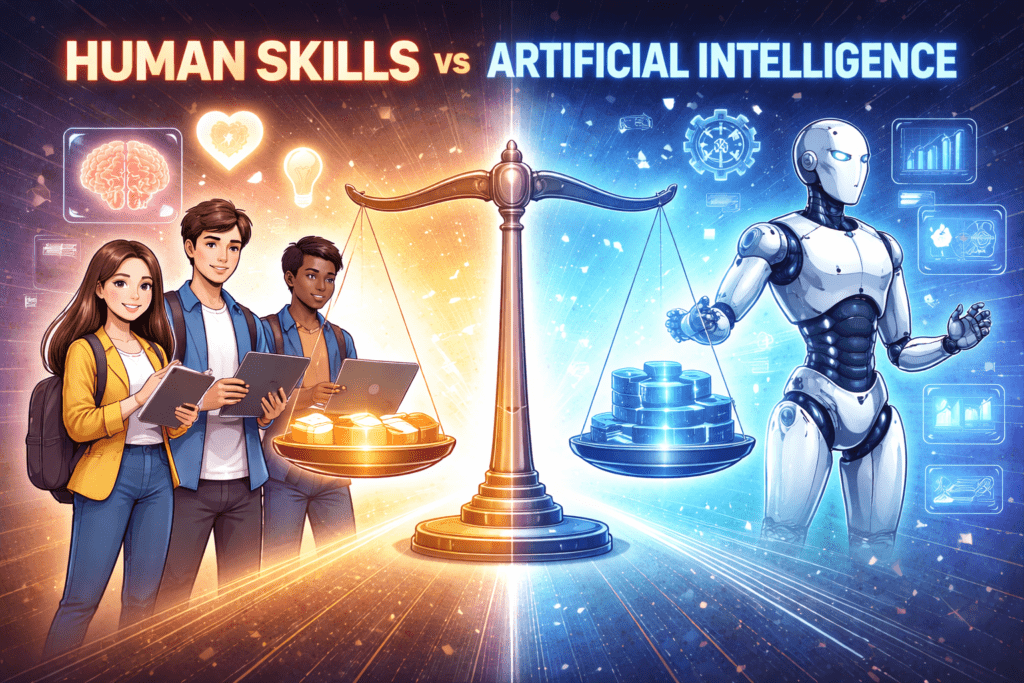
A New Reality for Students in the Age of AI
Artificial Intelligence (AI) is no longer a futuristic concept—it is a present-day reality reshaping industries, workplaces, and education systems across the globe. From AI-powered chatbots and automated customer service to advanced data analytics and content generation tools, machines are now capable of performing tasks that were once exclusively human. For students preparing to enter the workforce, this transformation raises an important and urgent question: What skills will make them irreplaceable in a world increasingly dominated by AI?
While AI excels in speed, accuracy, and data processing, it lacks the depth of human understanding, emotional intelligence, and creativity that define human capability. The future does not belong to those who compete with AI, but to those who can complement and leverage it effectively. This article explores the critical human skills that will remain valuable, why they matter, and how students and academic institutions can adapt to ensure long-term relevance and success.
The Rise of Artificial Intelligence: Opportunity and Disruption
AI technologies have advanced rapidly in recent years, influencing sectors such as finance, healthcare, education, and business. Tasks such as data entry, basic analysis, and even content creation can now be automated. For example, AI can generate reports, analyze large datasets, and even assist in decision-making processes.
This transformation brings both opportunities and challenges:
- Opportunities: Increased productivity, cost efficiency, and new career paths.
- Challenges: Job displacement, skill obsolescence, and increased competition.
Many entry-level roles—traditionally filled by graduates—are at risk of automation. This means that academic qualifications alone are no longer sufficient. Students must develop distinct human capabilities that AI cannot replicate.
Understanding the Limits of AI
To understand what makes humans irreplaceable, it is important to recognize what AI cannot do effectively:
- Lack of Emotional Understanding
AI can simulate conversation, but it does not genuinely understand emotions, empathy, or human experiences. - Limited Creativity
AI generates content based on existing data. It lacks true originality, intuition, and the ability to create meaning from lived experience. - No Moral Judgment
AI operates based on algorithms and data. It cannot make ethical decisions or understand complex moral dilemmas. - Contextual Weakness
AI struggles with ambiguity, cultural nuances, and rapidly changing contexts.
These limitations highlight the importance of human-centered skills in the future workforce.
Core Human Skills That Will Make Students Irreplaceable
1. Critical Thinking and Problem-Solving
In an age of information overload, the ability to evaluate, analyze, and make informed decisions is crucial. AI can provide data, but humans must interpret it.
Students need to:
- Question assumptions
- Identify biases in AI-generated outputs
- Solve complex, real-world problems
For example, in business, AI may suggest strategies based on data, but human judgment is required to assess risks, cultural factors, and long-term implications.
2. Creativity and Innovation
Creativity is one of the most powerful human advantages. While AI can assist in generating ideas, true innovation comes from human imagination and experience.
Students should develop:
- Creative thinking
- Design thinking
- The ability to connect unrelated ideas
In entrepreneurship, creativity drives:
- New business models
- Unique products and services
- Competitive differentiation
3. Emotional Intelligence (EQ)
Emotional intelligence refers to the ability to understand, manage, and respond to emotions—both one’s own and others’.
Key components include:
- Empathy
- Communication
- Relationship management
In careers such as teaching, leadership, counseling, and management, EQ is essential. AI cannot replace the human connection needed to motivate teams, resolve conflicts, or build trust.
4. Communication Skills
Effective communication remains a fundamental skill in any profession. This includes:
- Verbal communication
- Written communication
- Digital communication
Students must learn to:
- Present ideas clearly
- Persuade and influence others
- Collaborate across diverse teams
Even with AI-generated content, the ability to refine, contextualize, and deliver messages effectively is uniquely human.
5. Adaptability and Lifelong Learning
The rapid pace of technological change means that students must be prepared to continuously learn and adapt.
Important traits include:
- Openness to change
- Willingness to reskill and upskill
- Curiosity and self-motivation
The concept of a “fixed career path” is becoming obsolete. Instead, students must embrace lifelong learning to remain relevant.
6. Ethical Judgment and Integrity
As AI becomes more powerful, ethical concerns become more significant. Issues such as data privacy, bias, and misuse of AI require human oversight.
Students must develop:
- Strong ethical values
- Awareness of AI risks
- Responsible decision-making skills
In professional settings, ethical judgment can have serious consequences, making it a critical human skill.
7. Leadership and Teamwork
AI can assist in managing tasks, but it cannot lead people. Leadership involves:
- Inspiring others
- Making strategic decisions
- Managing uncertainty
Teamwork also requires:
- Collaboration
- Conflict resolution
- Cultural awareness
These are deeply human abilities that remain essential in any organization.
The Role of Education: Preparing Students for the Future
Educational institutions play a crucial role in shaping future-ready graduates. However, traditional education systems often focus heavily on memorization and theoretical knowledge.
To remain relevant, education must evolve in the following ways:
1. Shift from Content to Skills
Instead of focusing only on what students know, institutions should emphasize:
- How students think
- How they apply knowledge
2. Integrate AI into Learning
Students should not fear AI but learn how to use it effectively:
- AI as a research assistant
- AI for productivity and innovation
3. Encourage Experiential Learning
Practical experiences such as:
- Internships
- Projects
- Entrepreneurship programs
These help students develop real-world skills.
4. Promote Interdisciplinary Learning
Combining fields such as:
- Business + Technology
- Economics + Data Science
This prepares students for complex, modern challenges.
AI as a Tool, Not a Threat
One of the biggest misconceptions is that AI will replace humans entirely. In reality, the future lies in human-AI collaboration.
Students should view AI as:
- A productivity tool
- A learning assistant
- A partner in innovation
For example:
- Using AI to analyze data faster
- Using AI to generate ideas
- Using AI to automate repetitive tasks
This allows students to focus on higher-level thinking and creativity.
Real-World Applications: How Students Can Stay Ahead
To remain competitive, students must take proactive steps:
1. Build a Skill Portfolio
Beyond academic results, students should develop:
- Communication skills
- Digital skills
- Leadership experience
2. Engage in Side Projects or Entrepreneurship
Starting a small business or project helps students:
- Apply knowledge
- Develop problem-solving skills
- Gain practical experience
3. Learn How to Use AI Tools
Students should familiarize themselves with:
- AI writing tools
- Data analysis platforms
- Automation tools
4. Develop a Growth Mindset
Success in the future depends on:
- Continuous improvement
- Resilience
- Adaptability
The Future of Work: What Lies Ahead
The future workforce will be defined by:
- Hybrid roles combining human and AI capabilities
- Increased demand for soft skills
- Greater emphasis on innovation and adaptability
Jobs that require:
- Human interaction
- Complex decision-making
- Creativity
will continue to thrive.
Students who develop both technical and human skills will have a significant advantage.
Conclusion: Redefining What It Means to Be “Irreplaceable”
In a world where machines can perform many tasks faster and more efficiently than humans, being “irreplaceable” is no longer about possessing knowledge alone. Instead, it is about how individuals think, interact, and create value.
Human skills such as critical thinking, creativity, emotional intelligence, and ethical judgment are not just complementary to AI—they are essential. These skills enable students to navigate complexity, lead with empathy, and innovate in ways that machines cannot replicate.
For academic institutions, the challenge is to redesign education systems that prioritize these capabilities. For students, the responsibility is to embrace change, develop relevant skills, and view AI as a partner rather than a competitor.
Ultimately, the future belongs to those who can combine the best of both worlds: the efficiency of AI and the depth of human intelligence. By doing so, students will not only remain relevant but become truly irreplaceable in the evolving global economy.
References
Ruffin, M.A., Beier, M.E., Wu, F.Y., Voss, N.M., Javalagi, A.A. and Kell, H.J., 2026. Are we helping workers reskill for the future of work? Using AI to explore the alignment of online course offerings and job skill requirements. Journal of Intelligence, 14(4), p.59. Available at: https://www.mdpi.com/2079-3200/14/4/59
OECD, 2025. Artificial Intelligence and the Future of Skills. Paris: OECD Publishing. Available at: https://www.oecd.org/en/about/projects/artificial-intelligence-and-future-of-skills.html
World Economic Forum, 2026. In the age of AI, human skills are the new advantage. Available at: https://www.weforum.org/stories/2026/01/ai-and-human-skills/