 By Huong Fun Fun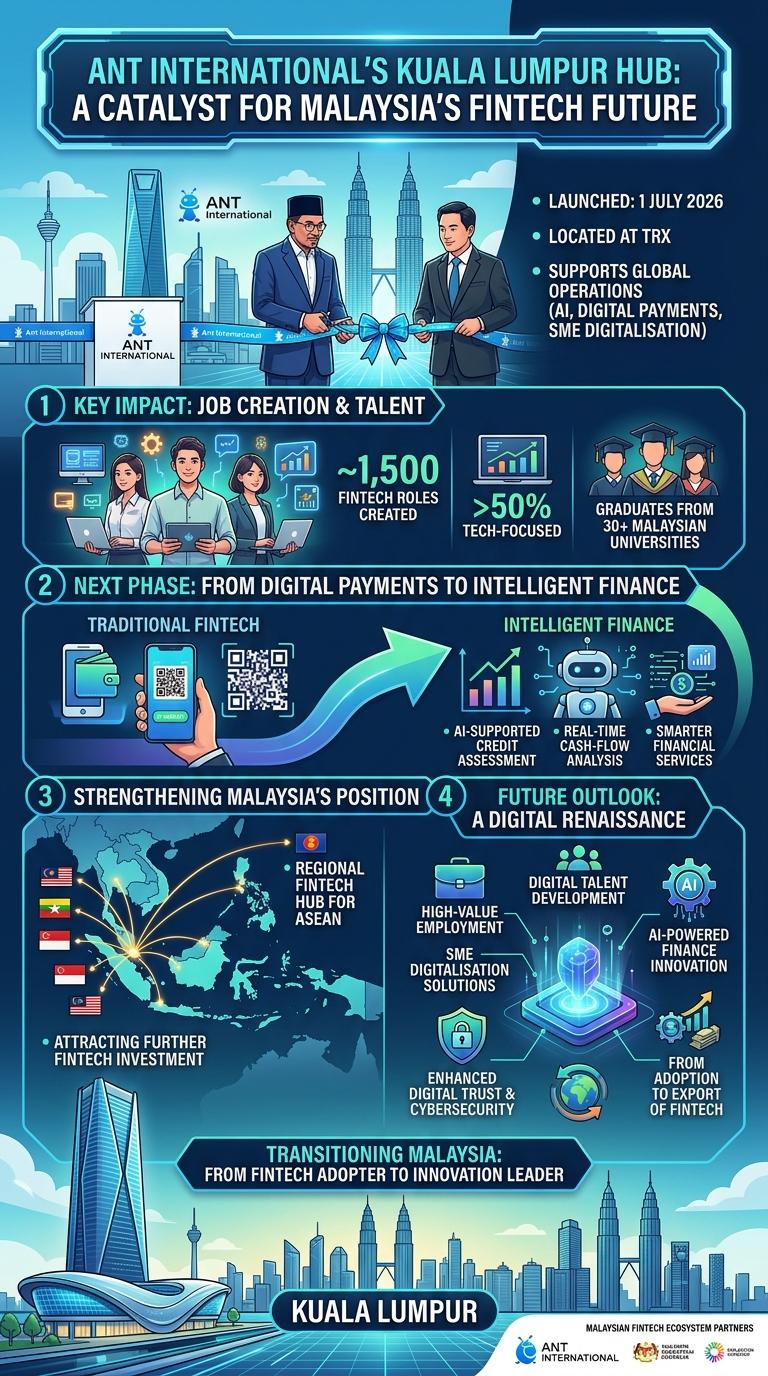
The launch of Ant International’s Kuala Lumpur hub marks an important milestone in the development of fintech in Malaysia. The new Global Development Centre and Global Operations Centre strengthen Kuala Lumpur’s position as a potential regional hub for financial technology, artificial intelligence (AI), digital payments and financial innovation.
On 1 July 2026, Prime Minister Datuk Seri Anwar Ibrahim officiated the opening of Ant International’s new Global Development Centre at Tun Razak Exchange (TRX), describing the development as part of a “digital renaissance” for Malaysia. More significantly, Ant International has positioned Malaysia as the location for its Global Operations Centre, supporting its international businesses in areas including AI, digital payments, SME digitalisation and fintech.
The scale of Ant International’s presence in Malaysia is particularly significant. The company has created around 1,500 fintech roles, with more than half focused on technology. Approximately half of its technology workforce comprises recent graduates from more than 30 Malaysian universities. This demonstrates not only the company’s confidence in Malaysia, but also the growing demand for Malaysian digital talent.
From Digital Payments to AI-Powered Fintech in Malaysia
Malaysia’s fintech development has accelerated significantly through online banking, e-wallets and cashless payments. However, Ant International’s investment suggests that the next phase of fintech development will go far beyond digital transactions.
The future of fintech will increasingly involve the integration of finance, data, AI and technology. Ant International’s Kuala Lumpur operations are expected to support areas such as digital payments, AI and SME digitalisation. Its activities in Malaysia have also included solutions aimed at helping SMEs adopt digital technologies and AI.
This represents an important shift. Fintech is no longer simply about allowing consumers to make payments through a smartphone or QR code. It is increasingly about using technology to make financial services faster, smarter, more accessible and more personalised.
For businesses, this could mean automated financial management, AI-supported credit assessment, real-time cash-flow analysis and easier access to cross-border payments. For consumers, it could mean personalised financial products, faster transactions and improved access to financial services.
Strengthening Malaysia’s Position as an ASEAN Fintech Hub
Ant International’s decision to establish a global centre in Kuala Lumpur also raises a broader question: Why Malaysia?
Malaysia has several advantages as a fintech location, including an established financial sector, widespread digital-payment adoption, a growing digital economy and strong connections with the wider ASEAN market. Its geographical position also provides access to a large and increasingly interconnected regional consumer and business market.
Cross-border payments are particularly important. As businesses increasingly operate across ASEAN, they require financial infrastructure that allows them to receive payments, transfer funds and manage transactions efficiently across different markets.
Ant International’s Kuala Lumpur hub could therefore help Malaysia move beyond being a consumer of fintech services towards becoming a developer, operator and exporter of fintech solutions.
This could also encourage further fintech investment. The presence of a major international fintech player may attract other technology companies, financial institutions, investors and start-ups, strengthening Malaysia’s wider fintech ecosystem.
The Real Competitive Advantage: Talent
Perhaps the most important long-term benefit of the hub is talent development.
The recruitment of fresh graduates from Malaysian universities demonstrates that local higher education institutions can play an important role in supplying talent for the emerging digital economy. Ant International has also highlighted initiatives involving AI and fintech talent development, creating opportunities for closer collaboration between industry and education providers.
This means future fintech professionals will require more than traditional banking or finance knowledge. They will increasingly need competencies in data analytics, AI, cybersecurity, digital payments, financial regulation and business strategy.
For Malaysian universities and colleges, this creates an important opportunity to rethink curriculum design. Accounting, finance and business graduates should not only understand financial principles; they should also understand how technology is transforming financial services and business decision-making.
Challenges and the Way Forward
Fintech growth also brings challenges. As financial transactions become increasingly digital and AI-driven, Malaysia will need to strengthen cybersecurity, data protection, fraud prevention, digital trust and responsible AI governance.
The country’s ability to attract fintech investment will therefore need to be matched by its ability to develop the talent and regulatory environment required to support sustainable innovation.
Outlook for Malaysia’s Financial Tedchnology Future
The Ant International Kuala Lumpur hub could have several important long-term implications:
- Regional fintech hub: Strengthen Kuala Lumpur’s position as a strategic fintech and digital-finance centre within ASEAN.
- High-value employment: Create more opportunities in AI, software development, data analytics, digital payments and financial technology.
- Digital talent development: Increase demand for Malaysian graduates with combined finance, technology and analytical skills.
- AI-powered finance: Accelerate the adoption of AI in areas such as risk management, fraud detection, financial analysis and customer services.
- SME digitalisation: Help Malaysian SMEs adopt digital payments, AI and integrated financial technologies.
- Cross-border finance: Support Malaysia’s role in developing more efficient regional payment and financial solutions.
- Fintech investment: Encourage other technology companies, investors and start-ups to establish operations in Malaysia.
- Education-industry collaboration: Create opportunities for universities and colleges to develop fintech-focused programmes, courses and industry partnerships.
- Digital trust and cybersecurity: Increase the need for stronger cybersecurity, data protection and responsible technology governance.
- From adoption to innovation: Enable Malaysia to progress from simply adopting fintech solutions to developing and exporting fintech solutions to ASEAN and beyond.
Ultimately, Ant International’s Kuala Lumpur hub should be viewed as more than a corporate investment. It is a potential catalyst for Malaysia’s transition from a digital-finance adopter to a regional fintech innovation and talent hub.
The next five to ten years will determine whether Malaysia can fully capture this opportunity. Success will depend not only on attracting international companies, but also on developing the talent, innovation ecosystem, infrastructure, cybersecurity and regulatory environment needed to retain high-value fintech activities.
If Malaysia succeeds, Kuala Lumpur could become more than a convenient location for fintech operations. It could become a regional centre where finance, AI, data and technology converge to create the next generation of financial services for ASEAN and beyond.
Read More:
1. The Sun — Anwar: Ant International’s KL hub marks digital renaissance (click here to read more)
2. New Straits Times — Ant International opens global development centre in Malaysia
Particularly useful for the 1,500 fintech roles, technology jobs and Malaysia’s role as a fintech hub. (click here to read more)
3. Ant International Unveils Global Development Centre in Malaysia, Expanding Commitment to AI, Talent, Trust and Digital Innovation (click here to read more)
4. The Future of Fintech in Malaysia 2026: A $12B Digital Revolution (click here to read more)