 By Aniza Elya Liyana Bt Md Ahsan
Future of Education: How Artificial Intelligence Is Transforming the Way We Learn
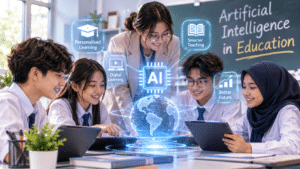
Discover 7 ways artificial intelligence in education is transforming learning through personalised education, smarter teaching methods, and digital innovation.
Introduction: Is the Traditional Classroom Becoming a Thing of the Past?
Imagine entering a classroom where every student receives a personalised learning experience. One student learns mathematics through interactive exercises, another improves their writing through instant feedback, while a third explores science through virtual simulations. Meanwhile, the teacher spends less time performing administrative tasks and more time helping students understand challenging concepts.
This is no longer simply an idea from a science fiction movie. Technology, particularly artificial intelligence (AI), is gradually transforming the education industry.
Artificial Intelligence in Education is transforming traditional classrooms by introducing smarter, more flexible, and interactive learning experiences.
Education has always evolved alongside society. From handwritten textbooks to digital libraries, each technological advancement has changed how knowledge is delivered and received. Today, artificial intelligence in education is creating new opportunities for students and teachers alike.
But does this mean traditional teaching methods will disappear? Not necessarily. Instead, the future of education may depend on finding the right balance between technology and human interaction. “Artificial Intelligence in Education is becoming an important part of modern learning, helping students access information and develop new skills more effectively.”
1. Personalised Learning: Education That Understands Every Student
One of the biggest challenges in traditional education is that students learn at different speeds.
“One of the greatest advantages of Artificial Intelligence in Education is its ability to create personalised learning experiences.”
In a typical classroom, a teacher may have 30 students, each with different strengths, weaknesses, interests, and learning preferences. Some students understand a lesson immediately, while others require additional explanations and practice.
Artificial intelligence can help address this challenge through personalised learning.
AI-powered educational platforms can analyse students’ learning progress, identify areas where they struggle, and recommend suitable learning materials. For example, a student who has difficulty understanding algebra may receive additional exercises and step-by-step explanations, while another student who has mastered the topic can move on to more advanced questions.
This approach allows students to learn at a pace that suits their individual needs.
Personalised education also encourages independent learning. Instead of waiting for the next classroom lesson, students can explore subjects, ask questions, and practise their skills whenever they need assistance.
However, technology should complement teachers rather than replace them. A computer can identify mistakes, but a teacher can understand the frustration, motivation, and emotions behind those mistakes.
The growing use of Artificial Intelligence in Education allows students to receive learning support based on their individual academic needs.
2. Artificial Intelligence as a Teaching Assistant
Teachers do much more than deliver lessons. They prepare teaching materials, develop assessments, mark assignments, monitor student progress, and manage classroom activities.
These responsibilities can become overwhelming, especially when teachers have large classes and limited preparation time.
Artificial intelligence can serve as a valuable teaching assistant by helping educators complete certain administrative and academic tasks.
For example, AI tools can assist teachers with:
- Developing lesson plans and classroom activities.
- Creating quizzes and multiple-choice questions.
- Generating examples to explain difficult concepts.
- Providing initial feedback on students’ written assignments.
- Organising learning materials and revision exercises.
By reducing time spent on repetitive tasks, teachers can dedicate more attention to student engagement, classroom discussions, and individual support.
Nevertheless, AI-generated content must be reviewed carefully. Teachers remain responsible for ensuring that information is accurate, relevant, and appropriate for their students.
The goal is not to create classrooms without teachers. It is to give teachers better tools to perform their jobs.
“Artificial Intelligence in Education also gives teachers opportunities to improve classroom management and develop more engaging learning materials.”
Artificial Intelligence in Education also helps educators reduce repetitive work and focus more on meaningful student interactions.
3. Learning Beyond the Classroom: Education Without Boundaries
In the past, access to education was often limited by geographical location, financial resources, and the availability of educational institutions.
Today, digital learning has made education more accessible than ever.
Students can attend online lectures, access digital textbooks, watch educational videos, and participate in virtual discussions without necessarily being physically present in a classroom.
For example, a student living in a rural community can access online courses offered by international universities. Someone working full-time can pursue professional qualifications through flexible online learning programmes.
This flexibility is particularly important in a rapidly changing job market, where individuals must continuously develop new knowledge and skills.
However, digital education also introduces challenges. Not everyone has reliable internet access, suitable devices, or a quiet environment for studying.
Therefore, educational institutions and governments must address the digital divide to ensure that technological progress does not create greater inequality.
Technology can open educational opportunities, but access must be available to everyone. With Artificial Intelligence in Education, digital learning platforms can provide students with additional resources regardless of their location.
“Through Artificial Intelligence in Education, students can explore digital resources and receive learning support beyond traditional classroom environments.”
4. The Hidden Danger: Are Students Becoming Too Dependent on AI?
Although artificial intelligence offers many advantages, its growing use in education raises an important question: Are students still learning if technology provides all the answers?
Consider a student who uses AI to complete an entire assignment without understanding the topic. The work may look impressive, but the student may gain very little knowledge from the experience.
This highlights the importance of critical thinking and academic integrity.
Students should learn how to use AI as a learning resource rather than a shortcut. For example, instead of asking AI to write an entire essay, students can use it to understand difficult concepts, generate discussion questions, or receive feedback on their own writing.
Educational institutions must also establish clear guidelines regarding acceptable AI use.
More importantly, students need to develop skills that technology cannot easily replace, including creativity, communication, problem-solving, emotional intelligence, and ethical decision-making.
The future belongs not simply to people who know how to use technology, but to those who know how to use it wisely.
Responsible implementation of Artificial Intelligence in Education is essential to ensure that students continue developing independent thinking skills.
“Despite its advantages, Artificial Intelligence in Education must be implemented responsibly to protect academic integrity.”
5. The Skills Students Need for the Future

The workplace is changing rapidly. Automation, artificial intelligence, and digital transformation are influencing how businesses operate and what employers expect from their employees.
As a result, education must prepare students for more than examinations.
Future graduates will need a combination of technical knowledge and transferable skills.
Some of the most important skills include:
Critical Thinking: The ability to evaluate information, identify problems, and make informed decisions rather than accepting every answer provided by technology.
Digital Literacy: Understanding how to use digital platforms, artificial intelligence, and online resources responsibly and effectively.
Communication: Expressing ideas clearly, collaborating with others, and building professional relationships.
Creativity: Developing original ideas and finding innovative solutions to problems.
Adaptability: Being willing to learn new skills and adjust to changing workplace requirements.
Educational institutions should integrate these skills into their teaching approaches through practical projects, case studies, group discussions, and real-world problem-solving activities.
Artificial Intelligence in Education encourages institutions to prepare students for a workplace increasingly influenced by digital technologies.
After all, the purpose of education should not simply be to prepare students for their next examination. It should prepare them for life.
6. Will AI Replace Teachers in the Future?
This is perhaps one of the most interesting questions surrounding the future of education.
While AI can explain concepts, generate learning materials, and provide immediate feedback, teaching involves much more than transferring information.
Teachers motivate students, recognise emotional difficulties, encourage curiosity, manage classroom relationships, and inspire confidence.
A student who struggles academically may not simply need another explanation. They may need encouragement, patience, or someone who believes in their ability to improve.
These human qualities remain essential to meaningful education.
Rather than replacing teachers, artificial intelligence is more likely to change their responsibilities. Educators may increasingly become learning facilitators, mentors, and guides who help students navigate information and develop independent thinking.
The classroom of the future will therefore need both technological innovation and human connection.
Although Artificial Intelligence in Education can support teaching activities, human educators remain essential to student development.
Conclusion: The Future of Education Is Human and Digital
Artificial intelligence is changing education by making learning more personalised, accessible, and flexible. It offers teachers new ways to prepare lessons, support students, and improve educational experiences.
However, technology alone cannot guarantee better education. Students still need guidance, encouragement, critical thinking skills, and opportunities to interact with others. Teachers remain essential in helping young people develop not only academic knowledge but also the values and abilities needed to succeed in society.
Ultimately, the future of education should not be about choosing between technology and traditional teaching. It should be about combining the strengths of both.
Artificial Intelligence in Education also presents an opportunity for educational institutions to rethink how knowledge is delivered. Schools, colleges, and universities can introduce innovative teaching strategies that encourage collaboration, independent research, and practical problem-solving. By embracing digital transformation responsibly, institutions can create learning environments that are better suited to the needs of modern students.
At the same time, governments and educators must ensure that technology remains accessible, safe, and inclusive. Students from different backgrounds should have equal opportunities to benefit from digital learning. Proper training for teachers, clear guidelines for AI usage, and continuous improvements in educational technology will be important in achieving this goal.
As technology continues to evolve, education must evolve with it. The most successful institutions will be those that recognise the importance of both innovation and human connection. Ultimately, Artificial Intelligence in Education should be viewed as a valuable tool for creating more inclusive, engaging, and effective learning environments.
Because the most successful education system will not be the one with the smartest technology, but the one that uses technology to help people become smarter, more creative, and more capable of shaping the future.