 By Huong Fun Fun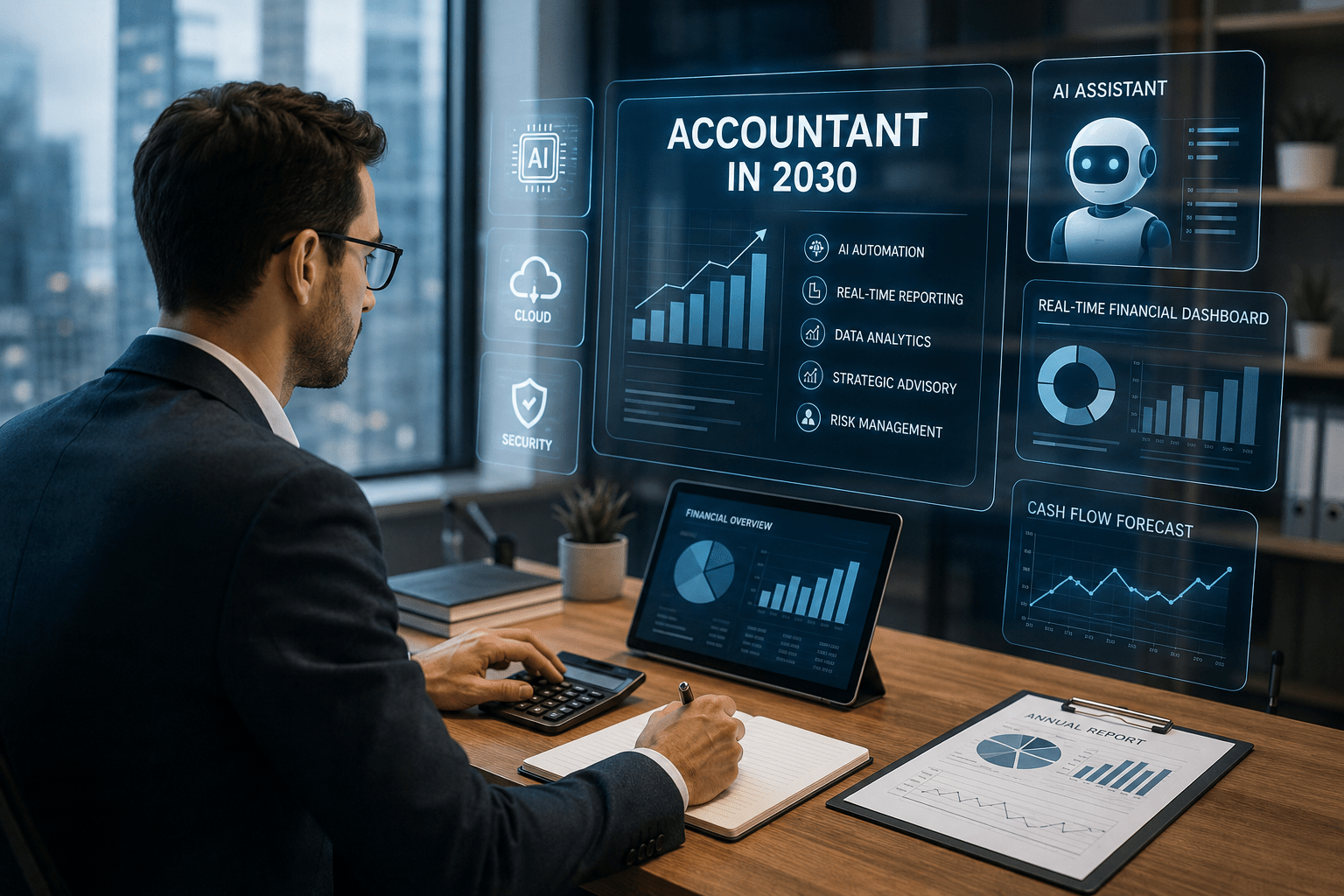
By 2030, the role of an accountant will look very different from today. Rather than being focused mainly on manual bookkeeping, data entry, and periodic reporting, accountants will evolve into strategic advisors, data interpreters, and AI-assisted decision makers. The profession is not disappearing—it is upgrading.
Driven by artificial intelligence, automation, and real-time financial systems, accounting in 2030 will be faster, smarter, and more integrated into business strategy than ever before. As highlighted in industry forecasts, AI is expected to handle repetitive tasks such as reconciliations, reporting, and compliance checks, allowing accountants to focus on higher-value work like forecasting and advisory services .
A widely cited industry study also predicts major structural changes, including real-time financial reporting, continuous auditing, and AI-driven risk management becoming standard practice across most organisations by 2030 .
Below is a clear breakdown of what the accountant of 2030 will look like.
1. From Bookkeeper to Strategic Advisor
In 2030, traditional bookkeeping will be heavily automated. AI systems will record transactions, match invoices, and generate financial statements instantly.
This means accountants will shift from:
- Data entry → Data interpretation
- Routine reporting → Strategic insights
- Historical reporting → Future forecasting
Instead of “what happened last month?”, the accountant will answer:
- “What will happen next quarter?”
- “What risks are emerging?”
- “What should the business do next?”
This transformation makes accountants more valuable, not less.
2. AI and Automation Will Handle Routine Work
Artificial Intelligence will become a daily partner in accounting workflows. Tasks likely to be automated by 2030 include:
- Bank reconciliations
- Invoice processing
- Payroll calculations
- Basic tax computations
- Compliance checks
Research shows AI can already significantly reduce manual processing time and improve accuracy in accounting workflows .
By 2030, AI will not just assist—it will execute many of these tasks autonomously under human supervision.
3. Real-Time Accounting Will Replace Monthly Reporting
One of the biggest changes is the move from periodic reporting to continuous accounting.
Instead of closing books monthly or quarterly, businesses will:
- Track finances in real time
- Detect errors instantly
- Update financial dashboards continuously
This means accountants will no longer “close the books”—they will monitor live financial systems.
Decision-making will become faster and more data-driven, with businesses relying on real-time insights instead of outdated reports.
4. The Rise of the “Tech-Savvy Accountant”
By 2030, accountants will need strong digital and analytical skills. Technical literacy will be as important as accounting knowledge.
Key skills will include:
- AI tools and automation systems
- Data analytics and visualization
- Cybersecurity awareness
- ERP and cloud accounting platforms
- Prompt engineering for AI tools
In fact, many firms are already developing new hybrid roles such as AI audit reviewers and automation compliance officers.
This shows that accounting is becoming a technology-driven profession, not just a financial one.
5. More Focus on Ethics, Judgement, and Advisory Work
Even with AI advancement, human judgement remains essential.
Accountants will increasingly focus on:
- Ethical decision-making
- Financial interpretation
- Business strategy advisory
- Regulatory compliance judgement
- Risk management and fraud detection
AI can process data, but it cannot fully replace human responsibility, professional scepticism, or ethical reasoning.
This is why the accountant of 2030 will be more like a financial consultant and decision partner rather than a traditional record keeper.
6. New Career Opportunities in Accounting
Rather than reducing opportunities, AI is reshaping them. New roles expected to grow include:
- Financial data analyst
- AI accounting system specialist
- Digital audit expert
- Business intelligence advisor
- Sustainability reporting accountant
Demand for accountants is expected to remain strong because businesses still need professionals to interpret data, ensure compliance, and provide trusted financial guidance.
7. The Human + AI Partnership
The future is not “AI replacing accountants”, but AI working with accountants.
AI will:
- Speed up processes
- Reduce human error
- Provide instant insights
Accountants will:
- Validate results
- Provide judgement
- Communicate insights to stakeholders
- Make strategic recommendations
This partnership will define the accounting profession in 2030.
Conclusion
By 2030, accountants will no longer be defined by spreadsheets and manual reports. Instead, they will become strategic professionals who work alongside AI to guide business decisions in real time.
The profession will evolve from number-crunching to insight-driven leadership. Those who adapt by learning digital tools, analytical thinking, and advisory skills will not only remain relevant—they will thrive.
Accounting is not dying in 2030. It is becoming smarter, faster, and more influential than ever before.
Read More:
- Career for Accounting Graduates: 10 Essential Skills in Digital Era (https://blog.fame.edu.my/career-accounting-graduates/)
- 2. 💡 The 3 Skills That Will Define Chartered Accountants in 2030 (https://www.linkedin.com/posts/saqib-iqbal-acca_charteredaccountant-professionaldevelopment-activity-7341328407445528576-Zwot/)
- 3. The Future of Accounting in 2030: Skills, Technology & Global Career Paths (https://academy.my-cpe.com/blog/future-of-accounting-2030)
- 4. Declining Accountant Jobs According to WEF by 2030?: Understanding the Shift, Not the End, of the Profession (https://blog.fame.edu.my/accountant-jobs/)