 By Vivian Lee Yao Ting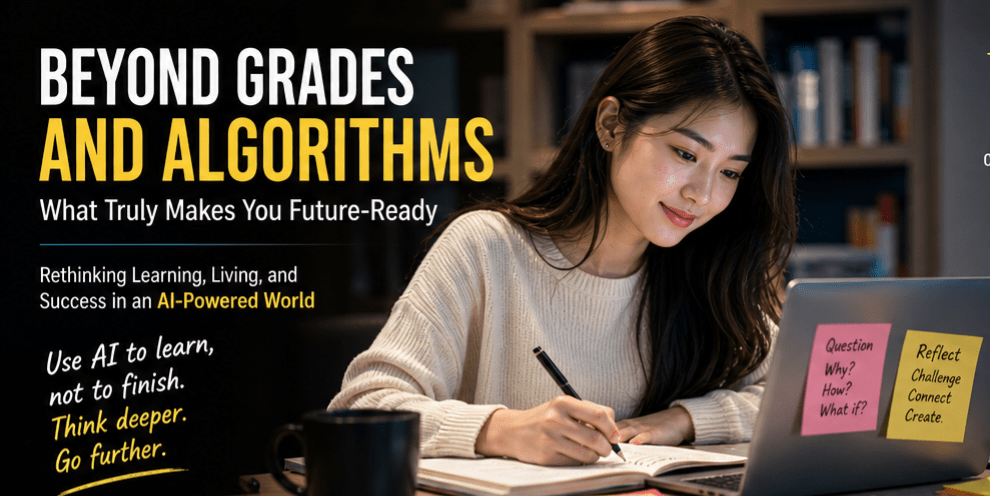
Introduction: The Night Before the Deadline
It’s 2:13 AM.
A student sits alone in their room, staring at a blinking cursor on their laptop. The assignment is due in less than 10 hours. The topic is complex, the readings are overwhelming, and the pressure is real.
Then, almost instinctively, they open an AI tool.
Within seconds, paragraphs begin to appear on the screen—structured, coherent, almost impressive. What would have taken hours now takes minutes. The stress fades. The deadline feels manageable again.
But as the student reads through the AI-generated answer, a quiet question lingers:
“If this tool can do my assignment… then what exactly am I learning?”
This moment is no longer rare. It is happening in hostels, dorm rooms, libraries, and homes across Malaysia and around the world. And while it may feel like a small, personal decision in the middle of the night, it reflects something much bigger.
We are not just witnessing the rise of AI in education.
We are witnessing a shift in what it means to be educated.
When Doing Well No Longer Means Learning Well
For many students, success has always been clearly defined. Study hard, complete assignments, perform well in exams, and graduate with good results. It is a system that rewards discipline, consistency, and effort.
But AI is quietly disrupting this model.
When a machine can generate essays, solve problems, and even explain concepts instantly, the meaning of “doing well” begins to change. A student can now produce high-quality work without fully understanding it. They can meet deadlines without experiencing the struggle that often leads to real learning.
At first, this feels like an advantage. But over time, it creates a gap—one that is not visible in grades, but becomes very clear in real life.
Because beyond the classroom, the world does not reward completed assignments. It rewards thinking, adaptability, and the ability to navigate uncertainty.
Case Study 1: Aina – The Top Student Who Felt Unprepared
Aina, a business student in Kuala Lumpur, had always been among the top performers in her class. Her assignments were polished, her presentations were confident, and her results were consistently strong.
During her final year, she began using AI tools more frequently. They helped her organise ideas, refine her writing, and complete tasks more efficiently. Like many students, she saw it as a smart way to manage her workload.
But everything changed during her internship.
Faced with real business challenges—ambiguous problems, unclear data, and the need to make decisions—Aina found herself struggling. There were no prompts to guide her, no instant answers to rely on. The workplace required her to think independently, ask the right questions, and navigate uncertainty.
Reflecting on her experience, she realised something important:
She had learned how to produce good work—but not always how to think deeply.
Her story is not a failure. It is a reflection of a system that is still catching up with the realities of an AI-driven world.
Malaysia’s Turning Point: More Than Just Digitalisation
Across Malaysia, institutions are actively integrating AI into education. Classrooms are becoming more digital, learning platforms more intelligent, and students more connected than ever before.
This transformation holds incredible promise. AI can personalise learning, making it easier for students to understand difficult concepts. It can provide instant feedback, helping them improve continuously. It can even open up new pathways for skills development and career planning.
But technology alone is not enough.
The real challenge is not whether we use AI—but how we use it.
Malaysia is now at a turning point where education must move beyond simply adopting new tools. It must redefine its purpose. It must ask deeper questions about what students truly need to succeed—not just academically, but in life.
Case Study 2: Daniel – Learning to Work With AI, Not Depend on It
Daniel, a diploma student in digital marketing in Selangor, had a different approach.
Instead of relying entirely on AI to complete his assignments, he used it as a starting point. He would generate ideas, then challenge them. He would ask follow-up questions, compare perspectives, and refine the output based on his own understanding.
At first, it took more time. But over time, something changed.
Daniel became more confident in his thinking. He started to see patterns, connect ideas, and develop his own voice. During group projects, he stood out—not because he had the best answers, but because he asked better questions.
By the time he entered the workforce, he was not just using AI—he was collaborating with it.
His advantage was not the tool itself, but how he chose to use it.
The Difference Between Assistance and Dependence
Stories like Aina’s and Daniel’s highlight an important distinction.
AI can be a powerful assistant. It can support learning, enhance productivity, and unlock creativity. But when it becomes a substitute for thinking, it turns into a limitation rather than a strength.
The line between assistance and dependence is subtle, but its impact is significant.
Students who depend on AI may achieve short-term success, but they risk long-term stagnation. On the other hand, students who engage with AI critically and thoughtfully develop skills that go far beyond the classroom.
Educators: The Human Element That Still Matters
In the midst of all this change, one thing remains constant: the importance of educators.
While AI can deliver information efficiently, it cannot replace the human connection that educators provide. It cannot fully understand a student’s struggles, motivations, or aspirations. It cannot inspire in the same way a passionate lecturer can.
This is why the role of educators is evolving.
They are no longer just delivering content—they are guiding journeys. They are helping students make sense of information, challenge assumptions, and discover their own perspectives. They are creating spaces where learning is not just about answers, but about exploration.
In many ways, their role is becoming more important, not less.
Case Study 3: A Classroom That Changed the Question
In one Malaysian college, a lecturer decided to redesign her assignments.
Instead of asking students to submit essays that could easily be generated by AI, she asked them to document their thinking process. Students were required to show how they used AI, what they agreed or disagreed with, and how their ideas evolved.
At first, students were unsure. It felt unfamiliar and more demanding.
But over time, something shifted.
Discussions became deeper. Reflections became more honest. Students began to take ownership of their learning, rather than simply focusing on the final output.
The assignment was no longer about producing the “right answer.” It was about developing the ability to think.
Beyond the Classroom: Preparing for a Different World
The changes in education are closely linked to changes in the workplace.
Employers today are not just looking for graduates who can follow instructions. They are looking for individuals who can adapt, communicate, and solve problems in complex environments.
AI is already transforming industries by automating routine tasks and creating new opportunities. In this landscape, technical skills alone are no longer enough. What matters is how individuals apply those skills, how they think, and how they interact with others.
This is where the true value of education lies—not in preparing students for a specific job, but in preparing them for a world that is constantly evolving.
Parents, Expectations, and the Redefinition of Success
For many parents, success has always been associated with academic achievement. Good grades, strong results, and stable careers have long been seen as the foundation of a secure future.
But the world is changing.
Today, success is increasingly defined by adaptability, resilience, and the ability to navigate uncertainty. Students need more than academic knowledge—they need the confidence to explore, the courage to fail, and the ability to learn continuously.
This requires a shift in mindset, not just for students, but for parents and society as a whole.
The Human Edge: What AI Cannot Replace
As powerful as AI is, it cannot replicate everything.
It cannot truly understand human emotion. It cannot experience failure, growth, or transformation. It cannot assign meaning to experiences in the way humans do.
These are not limitations to be overlooked—they are strengths to be embraced.
In a world where intelligence is increasingly automated, what makes individuals valuable is not just what they know, but how they think, how they feel, and how they connect.
Conclusion: Becoming More Than What AI Can Do
The student sitting at 2:13 AM, staring at an AI-generated answer, is not alone. That moment represents a choice that every student will face.
To use AI as a shortcut—or as a tool for growth.
To focus on outcomes—or to value the process.
To rely on intelligence—or to develop it.
The future does not belong to those who compete with AI.
It belongs to those who understand it, question it, and grow with it.
Because in the end, being future-ready is not about becoming more like machines.
It is about becoming more fully human in a world where machines are everywhere.
References
McKinsey & Company, 2025. Generative AI and the Future of Work in Education. Available at: https://www.mckinsey.com/featured-insights/future-of-work
UNESCO, 2025. Guidance for Generative AI in Education and Research. Paris: UNESCO Publishing. Available at: https://www.unesco.org/en/articles/guidance-generative-ai-education-and-research
Selwyn, N., 2024. Education and Technology: Key Issues and Debates. 3rd ed. London: Bloomsbury Academic.