 By Vivian Lee Yao Ting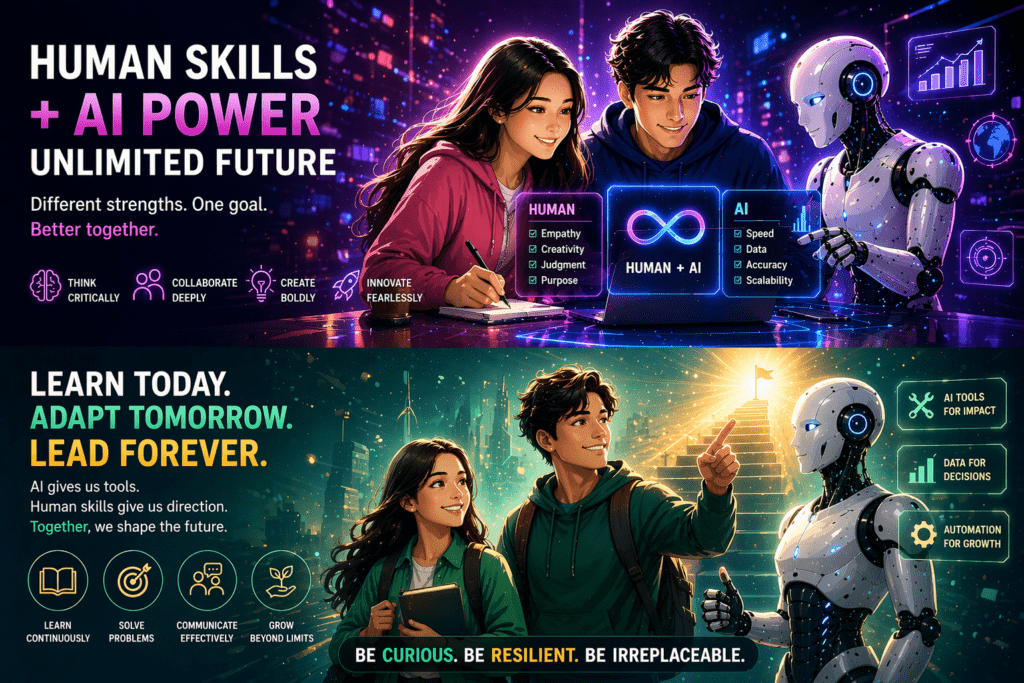
Redefining What It Means to Be a “Smart” Student
For generations, intelligence in education was defined by academic performance. A “smart” student was someone who could memorise information, perform well in exams, and follow instructions accurately.
In the age of AI, this definition no longer holds.
A truly capable student today is not the one who knows the most, but the one who can think the deepest. Intelligence is no longer about storing information; it is about making sense of it. It is about connecting ideas, questioning assumptions, and applying knowledge in meaningful ways.
Students must learn to move beyond simply consuming information. They must become active participants in their own learning, capable of navigating uncertainty and complexity. They must be willing to challenge what they are told, including what AI generates.
Perhaps most importantly, they must develop the ability to learn continuously. In a rapidly changing world, the most valuable skill is not what you know today, but how quickly you can adapt tomorrow.
From Dependency to Partnership: Learning to Work with AI
AI should not be seen as a threat to students, but neither should it be treated as a shortcut.
The most successful students of the future will be those who understand how to work with AI effectively. They will use it to enhance their thinking, not replace it. They will treat AI as a tool for exploration, a partner in creativity, and a support system for productivity.
However, this requires discipline and awareness.
Using AI to generate ideas can be incredibly useful, but relying on it entirely can weaken critical thinking skills. Copying answers without understanding them may produce short-term results, but it undermines long-term growth.
The key lies in balance. Students must learn to engage with AI thoughtfully, questioning its outputs, refining its suggestions, and integrating their own perspectives. In doing so, they transform from passive users into active co-creators.
Educators in Transition: From Lecturers to Learning Architects
While much of the focus is on students, educators play an equally critical role in this transformation.
The traditional role of educators as providers of knowledge is gradually evolving. In an age where information is readily available, their value lies not in delivering content, but in guiding understanding.
Educators are becoming architects of learning experiences. They are responsible for designing environments where students can think critically, collaborate effectively, and apply knowledge meaningfully. They provide mentorship, context, and human connection—elements that AI cannot fully replicate.
This shift, however, requires significant adaptation. Educators must develop new skills, embrace new technologies, and rethink traditional teaching methods. Without this evolution, the gap between technological capability and educational practice will continue to widen.
Beyond the Classroom: Why This Matters for Business and the Economy
The transformation of education is deeply connected to changes in the workforce and the economy.
Employers today are no longer looking solely for graduates with technical knowledge. They are seeking individuals who can adapt, communicate, and solve complex problems. They value creativity, emotional intelligence, and the ability to work collaboratively—both with people and with technology.
AI is reshaping industries by automating routine tasks and creating new opportunities. Jobs that rely heavily on repetition are becoming less relevant, while roles that require human insight and innovation are becoming more valuable.
This means that students who focus only on technical skills may find themselves at risk of being replaced. In contrast, those who combine technical knowledge with human capabilities will be better positioned to thrive.
In this context, education is not just about preparing students for jobs—it is about preparing them to create value in an unpredictable and evolving economy.
Parents and Society: Rethinking Success in a New Era
The transformation of education also requires a shift in mindset among parents and society.
For many years, success has been measured through grades, academic achievements, and traditional career paths. While these indicators remain important, they are no longer sufficient.
In a world shaped by AI, success is increasingly defined by adaptability, resilience, and the ability to navigate change. Students must be encouraged to explore, experiment, and develop a broader range of skills beyond academics.
Parents play a crucial role in this process. By supporting curiosity, encouraging independent thinking, and embracing new forms of learning, they can help prepare their children for a future that is fundamentally different from the past.
Ethics and Integrity: The Hidden Challenge of AI
As AI becomes more integrated into education, questions of ethics and integrity become more pressing.
The ability to generate essays, complete assignments, and produce high-quality work with minimal effort raises concerns about authenticity. But the issue goes beyond academic dishonesty.
At its core, it is about the loss of the learning process.
When students rely entirely on AI to produce outcomes, they miss the opportunity to struggle, reflect, and grow. These experiences are essential for developing critical thinking and problem-solving skills.
Educational institutions must therefore rethink how they assess learning. Instead of focusing solely on outputs, they must place greater emphasis on processes, creativity, and originality.
The Future Belongs to Hybrid Intelligence
The future is not a competition between humans and AI. It is a collaboration.
The most successful individuals will be those who can combine the strengths of both. They will use AI to enhance efficiency while relying on human qualities to provide meaning, context, and direction.
This concept of hybrid intelligence represents a new way of thinking about education, work, and life. It acknowledges that while AI can perform many tasks, it cannot replace the human capacity for creativity, empathy, and purpose.
Conclusion: The Real Answer to Being Irreplaceable
In a nutshell, what makes a student irreplaceable in the age of AI?
It is not just knowledge.
It is not just skills.
It is not even technical expertise.
It is the ability to remain deeply human in an increasingly intelligent world.
Students who can think critically, adapt continuously, create meaning, and work effectively with AI will not only survive—they will lead.
Because in the end, AI may be powerful, but it is still a tool.
And the true value lies in those who know how to use it wisely.
References
Jamaluddin, F., Jamaluddin, A.H., Jamaluddin, F. and Jamaluddin, F. (2025) Malaysia’s AI-Driven Education Landscape: Policies, Applications and Comparative Insights for a Digital Future. Available at: https://arxiv.org/abs/2509.21858
Necula, S.C. (2023) Artificial Intelligence Impact on the Labour Force: Searching for the Analytical Skills of the Future Software Engineers. Available at: https://arxiv.org/abs/2302.13229
Ruffin, M.A., Beier, M.E., Wu, F.Y., Voss, N.M., Javalagi, A.A. and Kell, H.J. (2026) Are we helping workers reskill for the future of work? Using AI to explore the alignment of online course offerings and job skill requirements. Journal of Intelligence, 14(4), p.59. Available at:
https://www.oecd.org/education/ceri/future-of-skills.htm