 By Vivian Lee Yao Ting
Beyond the Numbers: How Malaysia’s Fifth MADANI Budget Could Transform Workers’ Lives, SMEs, Businesses and the Next Generation
Introduction: A Budget Is More Than Money
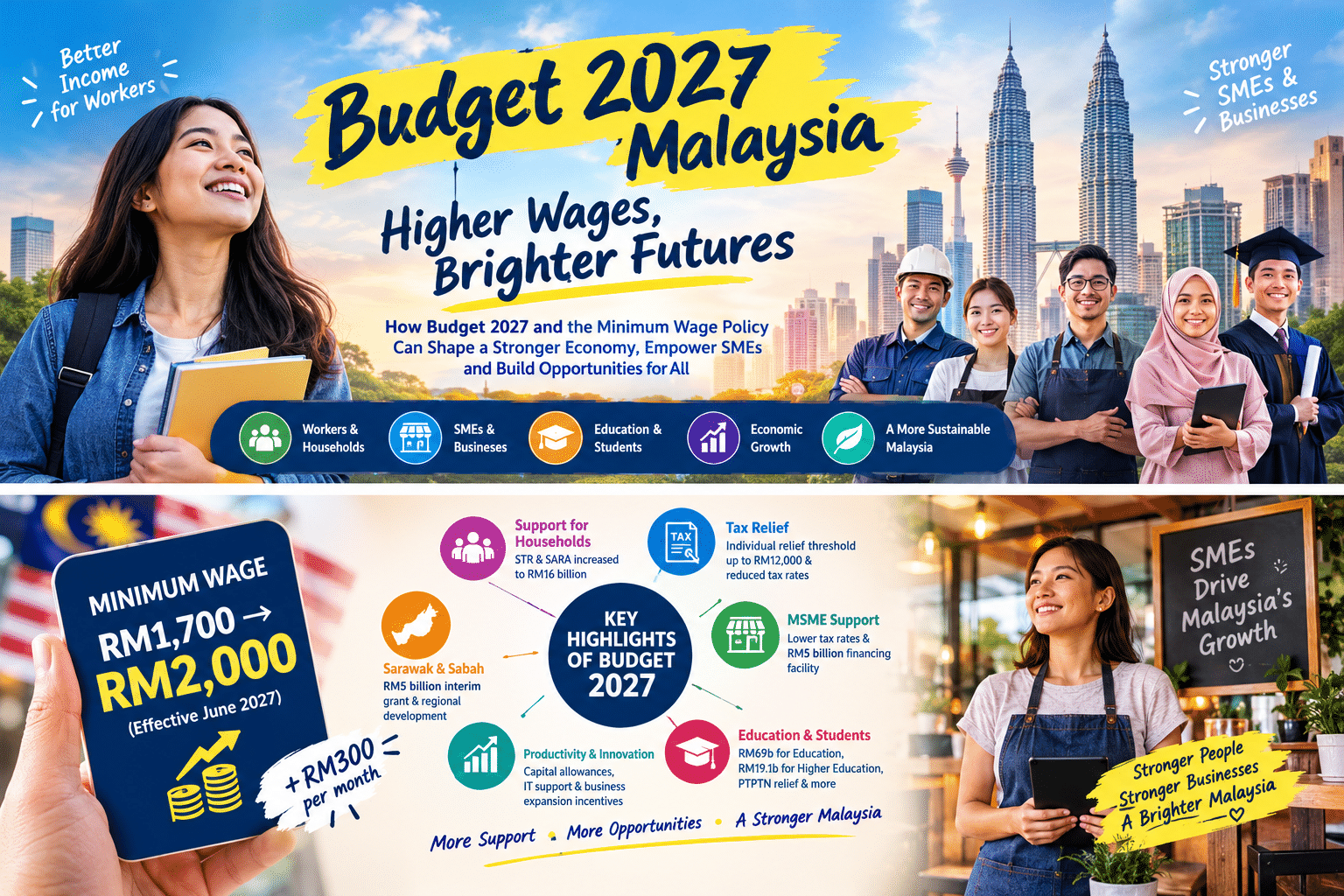
What does an extra RM300 a month mean to a Malaysian worker? It could mean more groceries in the shopping basket, fewer worries about monthly bills, additional savings for a child’s education, or simply a little more breathing room between payday and the end of the month.
For a small business owner, however, that same RM300 represents a different calculation: higher payroll expenses, tighter profit margins and potentially difficult decisions about pricing, staffing and business expansion.
These contrasting realities capture the central economic question behind Malaysia’s Budget 2027: How can a nation improve the livelihoods of its people while ensuring that its businesses remain competitive, productive and financially sustainable?
On 9 October 2026, Prime Minister and Finance Minister Dato’ Seri Anwar Ibrahim tabled the Fifth MADANI Budget 2027 in Parliament under the theme “Reaching for the Skies, While Anchored on Our Values” (Prime Minister’s Office of Malaysia, 2026a).
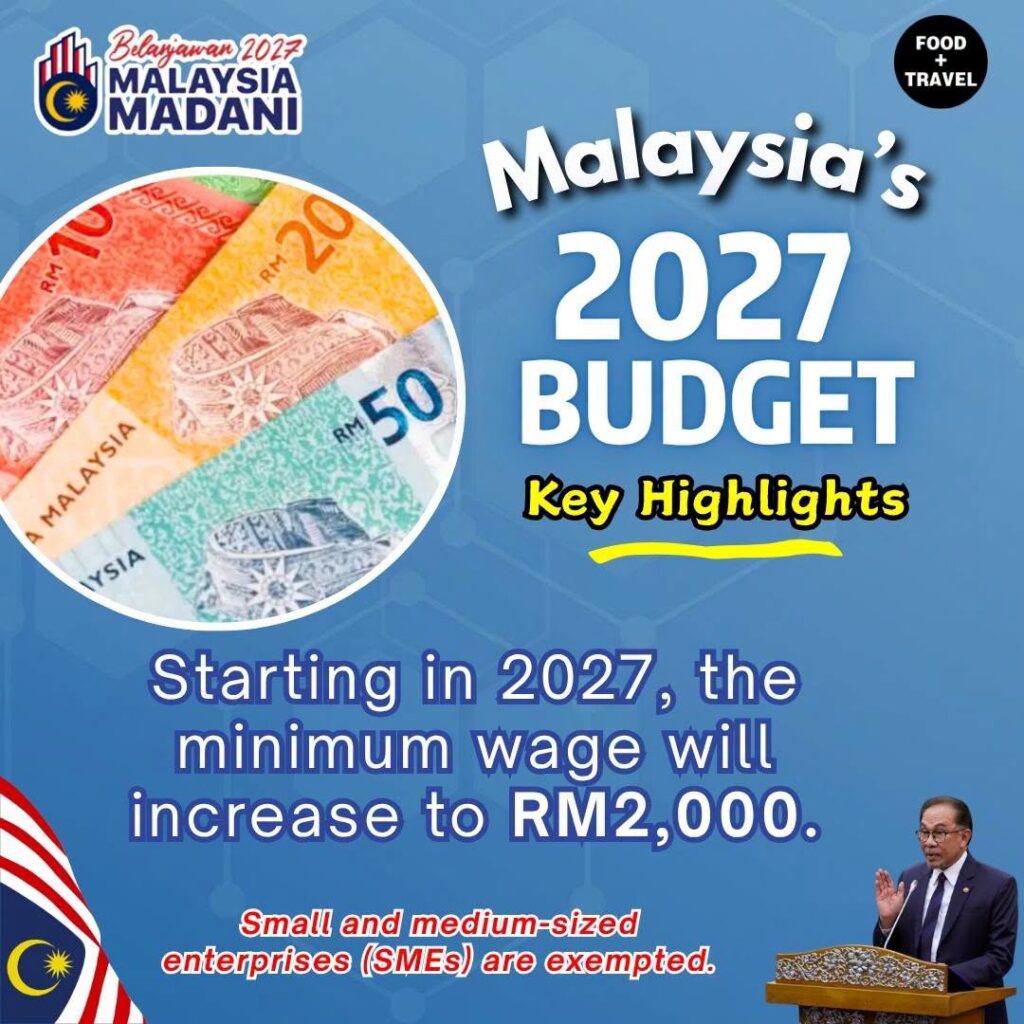
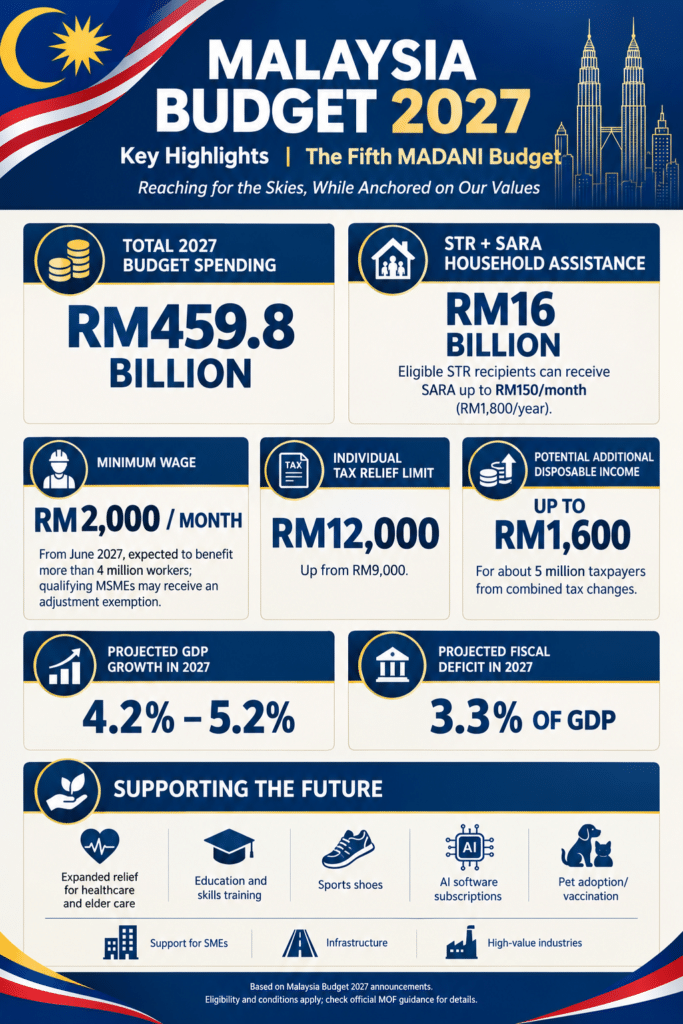
Among its most closely watched announcements was an increase in the national minimum wage from RM1,700 to RM2,000 per month, effective June 2027. The government expects more than four million workers to benefit, while micro, small and medium enterprises (MSMEs) with annual sales below RM50 million will initially be exempted to provide time for business adjustments.
The Budget also introduces a proposed minimum monthly wage framework of RM2,500 for semi-skilled workers and graduates, alongside measures addressing household assistance, education, taxation, entrepreneurship and economic development.
Yet a budget cannot be judged solely by the size of its allocations or the attractiveness of its announcements. Its real value lies in how effectively policies translate into better living standards, stronger businesses, productive employment and opportunities for future generations.
For students, lecturers, parents, entrepreneurs and working Malaysians, Budget 2027 offers an opportunity to examine the relationship between government policy and everyday economic life.
1. The RM2,000 Minimum Wage: A Bigger Paycheque or a Bigger Economic Question?
The minimum wage is the lowest legally prescribed wage that an employer must pay eligible employees covered by the relevant legislation and applicable requirements. It establishes an income floor intended to protect workers from excessively low remuneration.
Malaysia’s increase from RM1,700 to RM2,000 represents an additional RM300 per month, or RM3,600 annually for a worker receiving the new rate for all 12 months.
In percentage terms, the increase is approximately 17.65%.
This is a substantial adjustment for workers whose wages are currently at the minimum level. Nevertheless, the actual improvement in living standards will depend on inflation, household expenses, employment conditions and the extent to which higher earnings translate into greater purchasing power.
Why does the government want to raise wages?
One of the policy concerns highlighted in the Budget is the relationship between wages and productivity. The Prime Minister noted that employee compensation accounted for 33.9% of Malaysia’s gross domestic product (GDP), arguing that workers’ incomes had not kept pace adequately with rising prices (Prime Minister’s Office of Malaysia, 2026a).
GDP measures the value of goods and services produced within an economy. Employee compensation represents the remuneration received by workers. The relationship between these measures helps economists examine how the benefits of economic activity are distributed between labour and other recipients of income.
A growing economy does not automatically guarantee that every household experiences an improvement in its standard of living. If wages remain stagnant while housing, food, transport and other essential expenses increase, economic growth may feel distant from the daily realities of ordinary citizens.
The minimum wage adjustment is therefore intended to strengthen the income floor for workers and narrow the gap between economic output and workers’ remuneration.
Understanding the numbers
| Indicator | Amount |
|---|---|
| Existing minimum wage | RM1,700 monthly |
| New minimum wage | RM2,000 monthly |
| Monthly increase | RM300 |
| Annual increase, assuming 12 months at the new rate | RM3,600 |
| Percentage increase | Approximately 17.65% |
| Expected beneficiaries | More than 4 million workers |
| Effective date | June 2027 |
Source: Prime Minister’s Office of Malaysia (2026a). Calculations are illustrative and assume the worker receives the respective monthly rate for a full 12 months.
Consider a worker earning RM1,700 who receives RM2,000 after the new rate takes effect. The additional RM300 could support groceries, electricity bills, transport, childcare or emergency savings.
However, the higher wage does not automatically guarantee a 17.65% improvement in purchasing power. If prices rise, the real increase in what the worker can afford will be smaller.
The key question is not simply whether wages increase, but whether workers become financially better off after accounting for the cost of living.
2. From Workers’ Wallets to the Wider Economy
A minimum wage increase can influence the economy through several channels, beginning with household consumption.
In economics, consumption is an important component of aggregate demand. When lower-income households receive additional income, they may spend a significant proportion of it on necessities and everyday services.
For example, a worker who earns an additional RM300 may purchase more groceries, visit local food businesses, pay for transport or purchase essential household items. These transactions generate revenue for retailers, restaurants, transport providers and other businesses.
The additional spending may then support business activity and employment, creating a multiplier effect.
However, the size of this effect is not guaranteed. It depends on how much additional income households spend domestically, how much they save, whether they repay debts and how much spending flows towards imported products.
The potential economic benefits
First, stronger domestic demand. Higher disposable income among lower-wage households could support sales in consumer-facing industries, particularly food services, retail, personal services and everyday necessities.
Second, improved financial resilience. Workers may find it easier to manage routine expenses, repay debts and build modest emergency savings.
Third, improved employee morale. Fairer compensation can strengthen motivation, reduce financial stress and potentially improve employee retention.
Fourth, a possible reduction in income inequality. A minimum wage increase can narrow the gap between lower-paid workers and higher earners, although the overall effect depends on how wages and prices change throughout the economy.
These benefits are particularly important when economic growth needs to translate into tangible improvements in household welfare.
Nevertheless, higher wages are not a substitute for affordable housing, efficient public transport, accessible healthcare or effective social protection. A sustainable improvement in living standards requires a combination of income growth and measures that help control essential household expenses.
3. The Other Side of the Coin: What Happens to SMEs?
For Malaysia’s business community, the minimum wage increase presents both an opportunity and a challenge.
MSMEs are central to the national economy. The Budget speech states that they contribute approximately 40% of GDP and employ around eight million people, representing about half of the workforce (Prime Minister’s Office of Malaysia, 2026a).
These businesses include family-run restaurants, neighbourhood grocery shops, independent retailers, workshops, small manufacturers, childcare centres, service providers and growing technology enterprises.
Many operate with limited cash reserves and relatively narrow profit margins. A rise in payroll expenses can therefore have a more immediate impact on a small business than on a large corporation with substantial financial resources.
A simple business example
Imagine a small restaurant employing ten workers, all earning RM1,700 per month.
If all ten employees are eligible for the increase to RM2,000, the additional basic wage cost would be:
- RM300 extra per employee each month.
- RM3,000 in additional monthly basic wages for ten employees.
- RM36,000 in additional annual basic wages if the higher rate applies for 12 months.
This illustration excludes any associated changes in employer contributions, overtime, allowances or other employment costs.
For a restaurant already facing higher ingredient prices, rental expenses, utilities and delivery-platform charges, an additional RM3,000 a month could significantly affect cash flow.
Yet the same restaurant could potentially benefit if higher household incomes generate stronger customer demand.
The outcome depends on whether additional sales and productivity gains are sufficient to offset the increase in operating costs.
Which businesses may feel the greatest pressure?
Food and beverage businesses: Restaurants, cafés and food stalls may face pressure because they employ service staff and operate in competitive markets where customers are sensitive to price increases.
Retail and grocery businesses: Shops employing cashiers, sales assistants, warehouse workers and delivery personnel may experience higher wage expenses while competing with larger retailers.
Manufacturing and logistics: Labour-intensive manufacturers, warehouses and transport operators may need to review productivity, operating schedules, equipment and pricing strategies.
Childcare and personal services: Businesses that depend on employees to provide hands-on services may find it difficult to automate their operations or increase prices without affecting demand.
Hospitality and tourism: Hotels, restaurants and tourism operators may need to balance higher staffing expenses against seasonal demand and competition.
Importantly, the effect will vary across businesses. A company with strong sales growth and efficient operations may absorb the increase more easily than a business already struggling to cover its fixed costs.
Why the MSME exemption matters
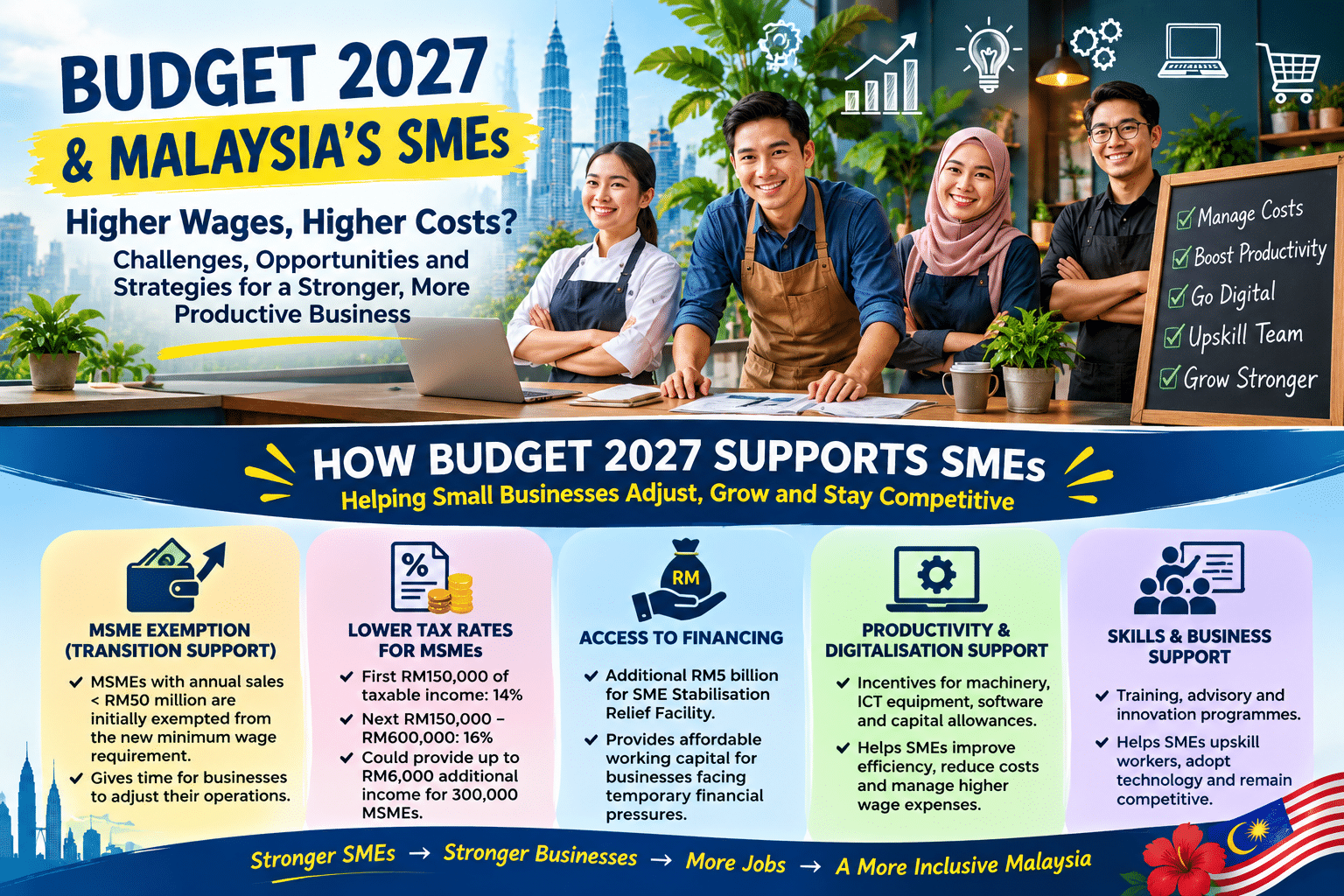
Budget 2027 provides an initial exemption from the new minimum wage requirement for MSMEs with annual sales below RM50 million, allowing them time to adjust their business models (Prime Minister’s Office of Malaysia, 2026a).
This distinction recognises that smaller businesses may have less capacity to absorb sudden increases in labour costs.
However, the exemption should not be interpreted as a permanent blanket exemption for every small business under all circumstances. Employers should consult the final legislation, official implementation guidance and applicable eligibility criteria before determining their obligations.
The policy challenge is to protect vulnerable workers without placing unnecessary pressure on businesses that are still building the capacity to grow.
4. Will Businesses Raise Prices, Reduce Hiring or Become More Productive?
One of the most important questions surrounding a minimum wage increase is how employers will respond.
Economic theory suggests several possible responses, and businesses may adopt more than one at the same time.
Scenario A: Businesses increase prices
A restaurant might raise selected menu prices to recover part of its additional payroll expenses. A retailer might adjust prices or delivery charges.
If many businesses increase prices simultaneously, consumers could experience renewed inflationary pressure.
However, higher wages do not automatically produce an equivalent increase in overall prices. The impact depends on labour costs as a proportion of total expenses, competition, demand, profit margins and productivity.
Businesses may also absorb some of the additional costs rather than passing them entirely to customers.
Scenario B: Businesses reconsider recruitment
Some employers may delay recruitment, reduce overtime or reorganise shifts to control expenses.
If labour costs rise substantially relative to the value of workers’ output, employers may become more cautious about hiring entry-level employees.
This is an important concern for young people seeking their first jobs, particularly in sectors where businesses traditionally recruit large numbers of inexperienced workers.
Nevertheless, employment outcomes are not determined by wage costs alone. Stronger consumer demand, lower employee turnover and improved productivity may offset some of the pressure.
Scenario C: Businesses invest in productivity
A more constructive response is to improve how work is organised.
Businesses could introduce digital ordering systems, inventory-management software, electronic payment systems, automated accounting processes or better staff scheduling.
For example, a café that reduces food wastage and improves stock management may recover part of its higher wage costs without increasing menu prices substantially.
Similarly, a small retailer that adopts digital inventory tracking may reduce administrative time, improve stock availability and allow employees to focus more on customer service.
The lesson is clear: higher wages become more sustainable when they are supported by higher productivity and better business management.
However, digitalisation also requires investment, training and reliable infrastructure. Not every small business can implement new technology immediately, which is why access to financing, business advice and practical training matters.
5. Beyond RM2,000: The Proposed RM2,500 Wage Framework for Graduates
Another significant announcement concerns the introduction of a minimum monthly wage framework of RM2,500 for semi-skilled workers and graduates.
This measure addresses a different problem: the relationship between education, skills and remuneration.
For many young Malaysians, obtaining a diploma or degree involves years of study, tuition expenses and, in some cases, student loans. Graduates naturally expect their qualifications to improve their employment prospects and earning potential.
However, possessing a qualification does not always translate into a salary that reflects the graduate’s skills, responsibilities or financial commitments.
The proposed RM2,500 framework signals an intention to address this mismatch.
For employers, it may encourage a more deliberate approach to entry-level salary structures, recruitment and employee development. For students, it reinforces the importance of evaluating prospective careers in terms of skills, employability and long-term progression rather than qualifications alone.
Nevertheless, the detailed eligibility rules and implementation mechanism will determine how the framework affects different occupations and employers.
What does this mean for colleges and universities?
Higher education institutions have a responsibility to prepare graduates for an economy in which employers increasingly value practical competence, digital literacy, communication, critical thinking and adaptability.
Business and economics students, for example, should be able to analyse financial statements, interpret market information, solve operational problems and communicate recommendations clearly.
Employers, meanwhile, should recognise that graduates need opportunities to apply their knowledge in real working environments.
The relationship between education and remuneration should therefore be strengthened through industry collaboration, internships, work-integrated learning, professional certifications and continuous skills development.
For students and parents, the message is not that every qualification guarantees a particular salary. Rather, education should be connected to meaningful competencies, realistic career pathways and opportunities for lifelong learning.
6. Budget 2027 and Its Broader Support for Households
Although the minimum wage announcement has attracted considerable attention, Budget 2027 also contains measures intended to support household spending and ease the cost of living.
According to the Prime Minister’s Budget speech, the combined allocation for Sumbangan Tunai Rahmah (STR) and Sumbangan Asas Rahmah (SARA) will increase to RM16 billion in 2027, compared with RM15 billion previously.
The government also announced the extension of monthly SARA assistance of up to RM150 to eligible STR recipients, potentially benefiting up to nine million Malaysians. Additional SARA MADANI assistance of RM100 on two occasions will be provided to eligible adults who are not STR recipients, subject to the announced conditions (Prime Minister’s Office of Malaysia, 2026a).
These measures are important because wage increases alone cannot address every household’s financial difficulties.
A family supporting children, elderly parents and a household mortgage may experience different financial pressures from a single young worker living independently. Targeted assistance can help eligible households manage essential expenses while wages provide a more direct source of employment income.
Tax relief for individuals
Budget 2027 also proposes increasing the individual income tax relief threshold from RM9,000 to RM12,000 and reducing selected resident individual income tax rates by one percentage point.
Additional tax relief measures include expanded provisions for education and skills training, parental and grandparental care, postpartum care, sports shoes, AI software subscriptions and certain pet-related expenses.
The government estimates that the expanded tax relief and reductions in selected individual income tax rates could provide approximately five million taxpayers with additional disposable income of up to RM1,600 (Prime Minister’s Office of Malaysia, 2026a).
For working parents and middle-income households, these measures could offer additional financial flexibility. However, actual savings depend on eligibility, taxable income, qualifying expenditure and the final tax rules.
The broader policy objective is to strengthen household financial resilience through a combination of employment income, targeted assistance and tax measures.
7. Supporting Businesses: Tax Relief, Financing and Innovation
A sustainable minimum wage policy needs a supportive business environment. If employers are expected to provide better wages, they also need opportunities to improve efficiency, invest in technology and expand their markets.
Budget 2027 addresses several aspects of this challenge.
Lower taxes for eligible MSMEs
The Budget proposes reducing selected MSME income tax rates by one percentage point. The rate for the first RM150,000 of taxable income is set to fall to 14%, while the rate for the next band, from RM150,000 to RM600,000, is set to fall to 16%, subject to the applicable conditions.
The government estimates that the measure could provide additional income of up to RM6,000 for 300,000 MSMEs (Prime Minister’s Office of Malaysia, 2026a).
For an eligible small business, these savings could help finance staff training, improve equipment, strengthen cash reserves or support gradual business expansion.
Nevertheless, the benefit will differ according to the company’s taxable income and eligibility. Businesses should not assume that every enterprise will receive the same amount of tax savings.
Encouraging investment and productivity
The Budget also proposes measures relating to capital allowances, machinery, information and communications technology equipment, software and financing arrangements.
These measures are relevant because productivity growth can help businesses manage higher wage costs over time.
A small manufacturer that invests in more efficient machinery may increase output without a proportional increase in working hours. A retailer that adopts digital accounting may reduce administrative burdens and improve financial visibility.
However, investment decisions must be based on a realistic assessment of costs, expected returns and business needs. Buying technology without a clear operational purpose can create additional financial pressure rather than improve productivity.
For this reason, business owners should consider whether each investment will reduce waste, increase output, improve customer experience or create opportunities for higher-value products and services.
Access to financing
Financing remains important for businesses that need working capital to purchase inventory, pay suppliers or manage temporary cash-flow difficulties.
Bank Negara Malaysia’s Budget 2027 announcement highlights an additional RM5 billion for the SME Stabilisation Relief Facility, intended to provide affordable working capital to businesses facing temporary financial pressures (Bank Negara Malaysia, 2026).
Access to financing can help eligible businesses remain operational while they adjust to changing market conditions. Nevertheless, borrowing should be accompanied by sound cash-flow management and a realistic repayment plan.
Taken together, tax relief, financing and productivity incentives can complement wage policy by helping businesses strengthen their capacity to pay workers more sustainably.
8. Education, Student Welfare and the Next Generation
Budget 2027 is also relevant to colleges, universities, educators, students and parents because education plays a central role in the country’s future workforce.
The Ministry of Education receives an allocation of nearly RM69 billion, while the Ministry of Higher Education is allocated RM19.1 billion. The Budget also provides RM800 million to upgrade higher education infrastructure, including lecture halls, student accommodation and obsolete equipment (Prime Minister’s Office of Malaysia, 2026a).
These investments matter because education is not merely a public expenditure. It is an investment in human capital: the knowledge, capabilities and skills that contribute to future productivity.
For students, better facilities and access to education can support learning outcomes and improve preparation for employment. For educators, investment in infrastructure can create opportunities to enhance teaching, practical learning and industry engagement.
The Budget also includes measures affecting students’ financial well-being. Early Schooling Aid will increase to RM200 per eligible pupil, while the government will provide a repayment deferment for eligible PTPTN borrowers earning up to RM2,500 a month in 2027. Eligible borrowers earning between RM2,500 and RM3,000 will face a minimum repayment of RM50, subject to the announced conditions.
Regular PTPTN borrowers without arrears will also be eligible for a 10% discount under the announced measure. In addition, the Dapur Siswa MADANI programme will be expanded to additional educational institutions, with meals offered through the programme at RM5 (Prime Minister’s Office of Malaysia, 2026a).
For students and parents, these initiatives demonstrate that economic policy extends beyond wages. Education costs, accommodation, food security and student debt all influence whether young people can pursue their studies and transition successfully into employment.
Colleges and universities can complement these efforts by strengthening career counselling, financial literacy education, internship opportunities and collaboration with employers.
9. What Does Budget 2027 Mean for Sarawak and Local Businesses?
For readers in Sarawak, the Budget’s implications extend to the state’s diverse economic landscape.
From Kuching’s retail and hospitality businesses to tourism operators, construction companies, agricultural enterprises and service providers in smaller towns, changes in wages and operating costs may affect businesses differently.
A family-owned café in Kuching, for instance, may need to review staffing arrangements and menu prices. A small tourism operator may need to improve booking systems and customer service to increase revenue per employee. An agricultural enterprise may explore better supply-chain coordination and technology to reduce wastage.
These are examples of how businesses could respond; the actual outcome will depend on each enterprise’s circumstances.
The Budget speech also addresses regional development, including infrastructure and economic opportunities in Sabah and Sarawak. It records an interim federal special grant of RM5 billion for the two states, alongside continuing discussions on a sustainable annual formula under the Malaysia Agreement 1963 (Prime Minister’s Office of Malaysia, 2026a).
For Sarawak, the long-term economic question is how public investment, connectivity, skills development and local entrepreneurship can create productive employment and stronger regional supply chains.
Higher wages are most sustainable when they are supported by a growing local economy that creates sufficient demand for goods and services.
If local businesses can expand their customer base, develop new products and improve productivity, they may be better positioned to provide higher remuneration while remaining competitive.
10. The Challenges Policymakers and Businesses Must Not Ignore
Despite its potential benefits, the minimum wage increase should not be treated as a complete solution to Malaysia’s cost-of-living and productivity challenges.
Several issues require attention.
Inflation and purchasing power. If prices rise faster than wages, workers may see only a limited improvement in their living standards. Policymakers must therefore monitor inflation and household affordability alongside nominal wage growth.
Business sustainability. Smaller employers may have limited financial capacity to absorb higher costs. Clear implementation guidance, access to financing and practical productivity support can help businesses prepare.
Employment opportunities. Employers may reconsider recruitment or working arrangements if wage costs increase faster than business revenue. Monitoring employment trends, particularly among young and inexperienced workers, will be important.
Wage progression. A minimum wage establishes a floor, not a complete career structure. Workers should have opportunities to improve their skills and progress towards higher-paying roles.
Productivity and competitiveness. Malaysia needs to strengthen the relationship between wages and the value created by workers. Better management, technology adoption, training and innovation can help achieve this goal.
The International Labour Organization (2016) emphasises that minimum wage systems should be designed and adjusted with attention to workers’ needs, economic conditions and the circumstances of employers. This reinforces the importance of evidence-based implementation rather than relying on wage increases alone.
Ultimately, successful policy requires a balance between fairness for workers and the ability of businesses to remain viable.
11. What Can Students, Parents and Future Entrepreneurs Learn?
Budget 2027 provides a practical opportunity to connect economic theory with real-world decision-making.
For economics students, the minimum wage increase illustrates how government intervention can influence labour markets, household consumption, business costs and employment decisions.
For business students, it highlights the importance of budgeting, human-resource planning, pricing strategies, cash-flow management and productivity.
For parents, it offers a reminder that household financial well-being depends not only on salary increases but also on spending choices, savings, education expenses and the cost of essential services.
For entrepreneurs, it reinforces the importance of building businesses that create value rather than competing solely through low labour costs.
Students entering the workforce should also recognise that employability involves more than academic qualifications. Communication, problem-solving, digital literacy, teamwork, adaptability and practical experience can help individuals contribute more effectively to organisations.
These capabilities matter because a stronger economy requires both businesses that can generate sustainable returns and workers who can participate meaningfully in economic growth.
Conclusion: A Fairer Wage, a Stronger Economy and a Shared Responsibility
Malaysia’s Budget 2027 presents an important policy milestone through its planned increase in the minimum wage from RM1,700 to RM2,000 per month, effective June 2027.
For eligible workers, the additional RM300 a month could provide meaningful support amid rising living costs. For businesses, particularly those with limited financial resources, the increase creates pressure to review operating costs, pricing, recruitment and productivity.
The accompanying measures on MSME taxation, financing, household assistance, education and skills development are therefore important parts of the wider economic picture.
The ultimate test of the Budget will not be whether wages rise on paper, but whether workers experience better living standards, businesses remain sustainable, young people gain meaningful employment opportunities and economic growth becomes more inclusive.
For policymakers, this means monitoring outcomes and ensuring that implementation is clear and effective. For businesses, it means investing in people, innovation and productivity. For educational institutions, it means preparing students to contribute to a changing economy. For households, it means making informed financial decisions while taking advantage of available support.
As Malaysia moves towards 2027, the challenge is not simply to pay workers more or help businesses spend less. It is to create an economic environment in which both workers and employers can prosper.
Because the real measure of a successful Budget is not just how much money moves through the economy, but how much opportunity, security and progress that money creates for the people who keep it moving.
References
Bank Negara Malaysia (2026) Belanjawan 2027. Available at: https://www.bnm.gov.my/-/belanjawan27-bm (Accessed: 10 October 2026).
International Labour Organization (2016) Minimum wage policy guide. Geneva: International Labour Organization. Available at: https://www.ilo.org/topics/wages/minimum-wages (Accessed: 10 October 2026).
Malaysia, Ministry of Finance (2026) Budget 2027: official budget documents and announcements. Available at: https://www.mof.gov.my/ (Accessed: 10 October 2026).
Prime Minister’s Office of Malaysia (2026a) Speech: The Fifth MADANI Budget 2027 by YAB PM. 9 October. Available at: https://www.pmo.gov.my/en/speeches-en/speech-the-fifth-madani-budget-2027-by-yab-pm/ (Accessed: 10 October 2026).
Prime Minister’s Office of Malaysia (2026b) Ucapan Belanjawan MADANI Kelima Tahun 2027. 9 October. Available at: https://www.pmo.gov.my/ms/ucapanterkini/ucapan-belanjawan-madani-kelima-tahun-2027-belanjawan-madani-kelima-menggapai-di-langit-mengakar-di-bumi/ (Accessed: 10 October 2026).