By Aniza Elya Liyana Bt Md Ahsan
 Education and Gaming: When the Classroom Starts Looking Like a Game
Imagine a student sitting in front of a computer.
They are completely focused.
They are solving problems, experimenting with different strategies, failing repeatedly, learning from their mistakes and trying again.
The interesting part?
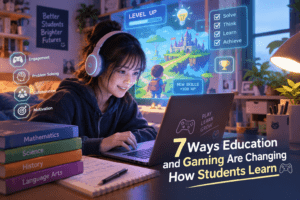
They are not doing homework. They are playing a game.
For years, gaming and education were often treated as opposites. Gaming was associated with entertainment, while education was associated with textbooks, lectures and examinations. But that distinction is becoming increasingly difficult to maintain.
Today, educators are exploring game-based learning and gamification as ways to make learning more interactive, motivating and meaningful.
And there is a fascinating question behind this movement:
What if students could learn using some of the same features that keep them playing games for hours?
Research suggests that the answer may be more promising than many people expect.
What Is Game-Based Learning?
Game-based learning (GBL) is the use of games as part of the learning process. Instead of simply adding points or rewards to a traditional lesson, the game itself becomes part of the learning experience.
For example, students might:
- Solve mathematical problems to progress through a game
- Manage a virtual business
- Explore a historical environment
- Complete language challenges
- Solve scientific problems
- Make decisions in a simulated environment
- Collaborate with classmates to complete missions
The important idea is that students are not simply learning about a concept.
They are using the concept to accomplish something.
This can make learning feel less like memorising information and more like solving a problem.
A systematic review of game-based learning in mathematics, for example, found that researchers have increasingly examined both cognitive and affective outcomes, including students’ academic learning and attitudes toward learning.
Gaming vs. Gamification: They Are Not the Same Thing
People often use gaming and gamification interchangeably, but there is an important difference.
Game-Based Learning
The game itself is used as the learning environment.
For example, students might play a simulation where they operate a virtual company and must make decisions about pricing, production and competition.
Gamification
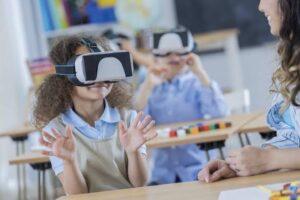
Gamification takes game elements and applies them to a non-game learning environment.
These elements might include:
- Points
- Badges
- Levels
- Challenges
- Leaderboards
- Rewards
- Progress bars
- Quests
- Immediate feedback
So a lecturer might turn a normal classroom activity into a series of “missions,” awarding points as students complete different learning tasks.
In other words:
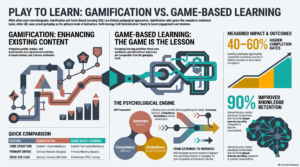
Game-based learning = learning through a game.
Gamification = adding game-like elements to learning.
That distinction matters because simply putting a leaderboard on a classroom activity does not automatically make the learning experience effective.
Why Does Gaming Make Learning More Engaging?
Here is where gaming becomes particularly interesting for education.
Good games are designed around something that traditional education sometimes struggles to achieve:
They give players a reason to keep going.
When players fail in a game, failure is rarely the end.
They try again.
They change their strategy.
They learn what went wrong.
They improve.
Then they try again.
That cycle can be valuable in education because learning itself often involves experimentation and failure.
Research supports the potential of gamification to improve educational outcomes. A meta-analysis covering 41 studies, 49 independent samples and more than 5,000 participants found a significant overall positive effect of gamification on student learning outcomes. However, the researchers also found that the effectiveness varied depending on factors such as the learner, subject, design principles, duration and learning environment.
In other words, games are not magic—but good educational game design can matter.
5 Ways Gaming Can Support Education
1. Gaming Can Increase Student Engagement
One of the biggest challenges in education is keeping students engaged.
A student may be physically present in a classroom while mentally somewhere else entirely.
Gaming introduces interaction.
Students make decisions, receive feedback and see the consequences of their choices. Instead of passively receiving information, they participate in an environment.
A 2024 systematic review examining gamification and school engagement identified 90 relevant interventions and highlighted the importance of looking beyond simple motivation to broader dimensions of engagement, including academic, emotional and behavioural participation.
2. Games Can Make Failure Less Frightening
Nobody likes getting an answer wrong.
But games have a strange ability to make failure feel like part of the process.
You lose a level.
You try again.
You discover a better strategy.
You progress.
This creates an environment where mistakes can become information rather than simply punishment.
For education, that can be powerful.
Students can experiment with different approaches without feeling that one wrong answer permanently defines their ability.
3. Games Can Develop Problem-Solving Skills
Many games require players to analyse information, identify patterns and make decisions.
Consider a strategy game.
A player might have limited resources, competing objectives and an uncertain outcome. They need to decide what to do next based on the information available.
That resembles many real-world problems.
Students may therefore practise skills such as:
- Critical thinking
- Decision-making
- Strategic planning
- Problem-solving
- Logical reasoning
- Resource management
The challenge for educators is to ensure that these skills are connected to meaningful learning objectives rather than assuming that any game automatically produces educational benefits.
4. Games Can Encourage Collaboration
Gaming does not always mean sitting alone in front of a screen.
Multiplayer and collaborative games can require students to communicate, divide responsibilities and solve problems together.
This creates opportunities to develop social and teamwork skills.
A classroom could, for example, give different students different roles in a simulated business.
One student might manage finance.
Another handles marketing.
Another analyses competitors.
Another makes strategic decisions.
Suddenly, the classroom becomes a small organisation—and students have to figure out how to make it work.
5. Games Can Provide Immediate Feedback
Traditional education often follows this pattern:
Learn → Complete assignment → Submit → Wait → Receive feedback.
Games frequently work differently:
Act → Receive feedback → Adjust → Try again.
That immediate feedback loop can help students understand the relationship between their actions and outcomes.
Modern gamified learning environments can also use adaptive technologies to personalise learning experiences. Recent research into AI-supported gamified learning environments has reported positive effects on school science learning outcomes, although researchers also caution that results vary across contexts and that more longitudinal research is needed.
But Is Gaming Always Good for Education?
Absolutely not.
And this is where the conversation becomes much more interesting.
Adding a game to education does not automatically make education better.
A badly designed educational game can still be boring.
A game with too many rewards can distract students from the actual learning objective.
And a leaderboard may motivate some students while discouraging others.
Researchers have repeatedly pointed out that the effectiveness of gamification depends on how it is designed and implemented. Infrastructure, resources, teacher capability and theoretical guidance can all influence the success of game-based learning in classrooms.
There are also practical concerns involving:
- Screen time
- Digital access
- Cost
- Teacher training
- Student differences
- Accessibility
- Privacy and data
- Distraction
- Over-reliance on rewards
Therefore, the goal should not be:
“Let’s turn everything into a game.”
The better question is:
“What can gaming do that helps students learn this particular concept better?”
The Future: From Playing Games to Learning Through Games
The relationship between education and gaming is likely to become even more interesting as artificial intelligence, adaptive learning and interactive technologies develop.
Imagine a learning game that changes its difficulty according to a student’s performance.
A student struggling with a concept receives additional challenges and explanations.
A student who has mastered it moves forward.
The game becomes less about simply collecting points and more about creating a personalised learning experience.
Recent research combining AI and gamification is already exploring this direction, including adaptive and generative AI systems designed to personalise learning pathways and increase engagement.
This could eventually shift the role of educational games from simple classroom entertainment toward interactive learning environments.
So, Can Video Games Make Students Smarter?
Not automatically.
Playing a game does not magically make someone smarter.
But well-designed games can create opportunities for students to practise thinking, decision-making, problem-solving, collaboration and persistence.
The real educational value is not necessarily the game itself.
It is the learning experience created around the game.
A good teacher knows when to explain.
A good game knows when to challenge.
And the most effective combination may be when the two work together.
Final Thoughts: Maybe the Classroom Doesn’t Need to Look Like a Classroom
For generations, education has often been associated with desks, textbooks, whiteboards and examinations.
Gaming challenges that image.
It asks us to consider whether learning always needs to look serious to be meaningful.
Perhaps a student solving a virtual problem, failing five times and finally succeeding is learning something more valuable than simply memorising the correct answer.
Perhaps the future of education is not about choosing between learning and gaming.
Perhaps it is about understanding why games can make people want to learn—and using those principles responsibly.
Because the ultimate goal isn’t to make education feel like a game.
It’s to make learning something students actually want to keep playing with.
How Gaming Can Support Different Types of Learners
One of the most interesting advantages of gaming in education is its ability to provide students with different ways to interact with information. Traditional classrooms often rely heavily on lectures, written materials and examinations. While these methods can be effective, they may not work equally well for every student.
Educational games can introduce another layer of learning through visuals, sound, interaction, storytelling and decision-making.
For example, a history game could allow students to explore a virtual historical environment and make decisions based on the social, political and economic conditions of a particular period. Instead of simply reading about an event in a textbook, students can experience a simplified version of the challenges faced by people at that time.
Similarly, science students could use simulations to experiment with concepts that may be difficult or expensive to reproduce in a physical classroom. They could change variables, observe results and repeat an experiment several times. This creates an opportunity for students to learn through experimentation rather than memorisation.
Gaming Can Turn Students Into Active Participants
There is another important difference between traditional learning and game-based learning: the role of the student.
In a conventional lesson, students may listen while the teacher explains a concept. In a game, students are often required to make decisions themselves.
Should they spend their limited resources now or save them for later?
Should they take a risk or choose the safer option?
Should they work independently or cooperate with another player?
These decisions can create meaningful learning opportunities.
For business and entrepreneurship education, for instance, a simulation could allow students to manage a virtual company. They might decide how much to produce, determine prices, create marketing strategies and respond to competitors. When the virtual business succeeds or fails, students can examine the consequences of their decisions.
This makes abstract concepts more concrete.
Instead of asking students to memorise the definition of supply and demand, an educational simulation could allow them to experience what happens when demand suddenly increases while supply remains limited.
Suddenly, the graph in the textbook has a story behind it.
The Power of Motivation
Gaming can also introduce a sense of progress. Students can see their achievements through levels, completed challenges, scores or unlocked content.
This can be particularly useful when learning a difficult subject. A large assignment can feel overwhelming, but breaking it into smaller challenges can make the learning process feel more manageable.
However, the strongest educational games do not rely entirely on rewards. They create intrinsic motivation by making the activity itself interesting and meaningful.
That distinction is important.
The goal should not be to teach students that every learning activity requires a prize.
Instead, educational gaming should help students discover something much more valuable:
the satisfaction of solving a difficult problem and finally understanding how it works.
When that happens, gaming is no longer simply entertainment.
It becomes another tool through which students can explore, experiment, fail, improve and learn.